SAST vs DAST: What’s the Difference?

Written By
Sarwat Iftikhar
Most conversations about application security testing eventually arrive at the same question: should we use SAST or DAST? The honest answer is that the question itself misses the point. SAST and DAST are not competing tools that solve the same problem in different ways. They solve different problems at different points in the development lifecycle, and they find different vulnerability classes that the other consistently misses.
Understanding what each approach actually does, and where each falls short, is what allows security teams to use both effectively rather than picking one and assuming it covers the job.
Key Takeaways
- SAST analyzes source code without executing it, finding vulnerabilities in how code is written before the application is deployed. DAST tests the running application from the outside, finding vulnerabilities that only manifest at runtime.
- SAST requires access to source code and runs during development. DAST requires a deployed application and runs after deployment. The two operate at different points in the SDLC.
- Neither SAST nor DAST reliably finds business logic flaws, complex authorization failures, or IDOR vulnerabilities. These require manual penetration testing regardless of what automated tooling is in place.
- In Bugstrix application security assessments, the critical findings that cause real breaches are disproportionately concentrated in the vulnerability classes neither SAST nor DAST covers well. Automated tooling provides breadth. Manual testing provides the depth that matters most.
- The most effective application security programs use SAST and DAST together as complementary layers, alongside manual penetration testing and expert code review, rather than treating any single approach as sufficient.
What Is the Core Difference Between SAST and DAST?
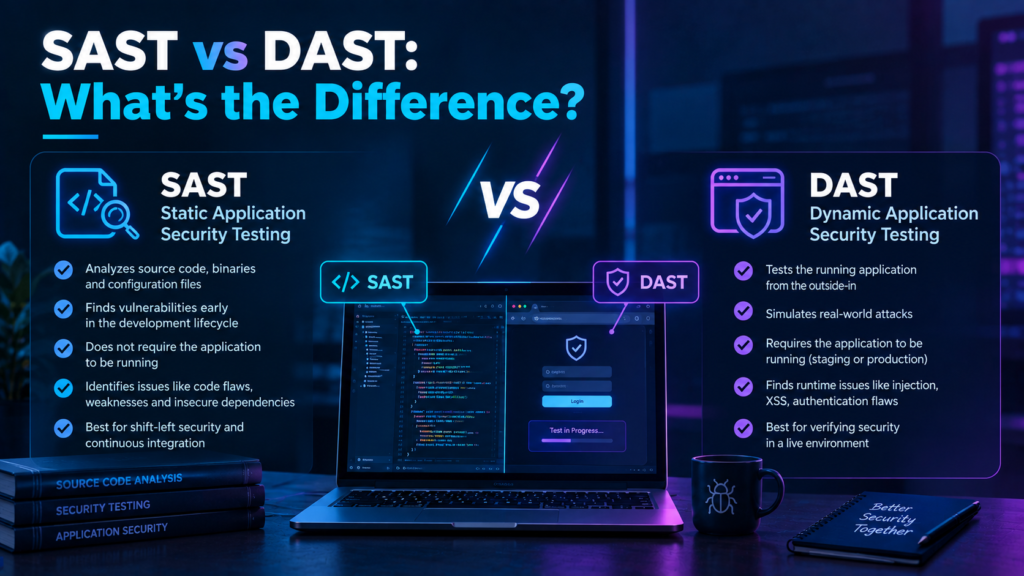
SAST and DAST differ in one fundamental way: the position from which they test. SAST operates on source code without executing it, examining the code itself for security weaknesses. DAST operates on the running application from the outside, interacting with it through its interface the way an attacker would. That positional difference determines everything else: when each runs, what each finds, and where each falls short.
A useful way to hold the distinction is this: SAST finds vulnerabilities in how the application is built. DAST finds vulnerabilities in how it behaves when deployed. Both are necessary because the two perspectives reveal different things and neither view is complete on its own.
Our dedicated posts on Static Application Security Testing and Dynamic Application Security Testing cover each approach in depth. This post focuses specifically on how they compare and how they work together.
How Does Each Approach Test an Application?
SAST and DAST test applications through fundamentally different mechanisms, which is why they produce different finding profiles even when applied to the same application.
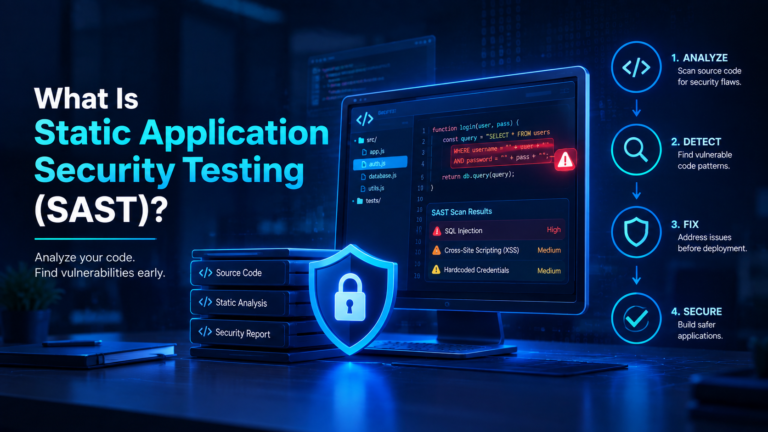
SAST parses source code, bytecode, or compiled binaries through pattern matching, data flow analysis, and control flow analysis. It traces how data moves through the codebase from user-controlled inputs to sensitive operations, identifying points where that data reaches an unsafe function without adequate sanitization, where cryptographic operations are implemented incorrectly, or where secrets are embedded directly in the code. It does all of this without executing the application, which means it can run on code that has not yet been deployed and can theoretically cover every code path, including those that are difficult to trigger through normal application use.
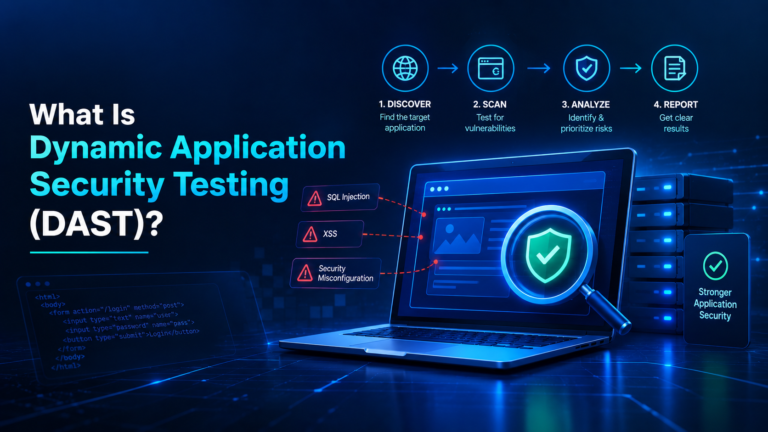
DAST sends crafted inputs to the running application through its external interface and analyzes the response behavior. It does not know what is inside the application. It discovers the attack surface by crawling, submits payloads designed to trigger specific vulnerability classes, and interprets the application’s responses to determine whether a vulnerability was triggered. Its findings are grounded in actual runtime behavior, which eliminates a category of false positives that SAST generates by flagging theoretically vulnerable patterns that are not actually exploitable in the deployed context.
What Vulnerabilities Does Each Approach Find?
The finding profiles of SAST and DAST overlap in some areas and diverge significantly in others. Understanding the specific vulnerability classes each covers is what allows security programs to use both strategically rather than redundantly.
| Vulnerability Category | SAST | DAST |
| Hardcoded secrets and credentials | Yes | No |
| Cryptographic implementation errors | Yes | Rarely |
| Insecure deserialization | Yes | Rarely |
| Race conditions and TOCTOU flaws | Yes | No |
| Dependency vulnerabilities | Yes | Partial |
| SQL and command injection | Yes | Yes |
| Cross-site scripting | Yes | Yes |
| Authentication weaknesses | Partial | Yes |
| Missing security headers | No | Yes |
| SSRF vulnerabilities | Partial | Yes |
| Business logic flaws | No | No |
| Complex authorization failures (IDOR) | No | No |
| Multi-tenant isolation failures | No | No |
The overlap zone in the middle of this table, where both approaches find the same vulnerability class, is actually where the two tools complement rather than duplicate each other. SAST finds injection and XSS vulnerabilities in code patterns that may include code paths not exercised during dynamic testing. DAST confirms which injection and XSS findings are genuinely exploitable in the deployed environment and finds runtime-specific manifestations that static analysis misses.
The bottom three rows of the table are the most significant from a real-world breach perspective. Business logic flaws, complex authorization failures, and multi-tenant isolation issues are neither SAST nor DAST territory. They require a tester who understands the application’s intended behavior and can design test cases around the specific permission model and business rules that the code is supposed to enforce. In Bugstrix application security assessments, these categories account for the majority of critical and high-severity findings, which is why manual testing remains essential regardless of what automated tooling is in place.
How Do SAST and DAST Compare on False Positives?
SAST generates higher false positive rates than DAST because it operates without deployment context. A code pattern that looks vulnerable in isolation may be protected by a compensating control elsewhere in the codebase, by a framework-level sanitization function the static analyzer does not recognize, or by a configuration that limits its exploitability in the actual deployment environment. SAST flags the pattern without knowing whether those mitigating factors are present.
DAST generates fewer false positives because its findings are grounded in actual runtime behavior. When a DAST tool identifies a SQL injection vulnerability, it has sent a payload and received a response that confirms the injection was processed. The exploitability is confirmed by the test itself rather than inferred from a code pattern.
In practice, this means SAST findings require more human triage to distinguish genuinely exploitable vulnerabilities from theoretical concerns. Development teams that receive unfiltered SAST output quickly develop alert fatigue if the tooling is not tuned for the specific codebase and framework. DAST findings require less triage at the individual finding level but may miss coverage gaps where the crawling phase did not discover the full application attack surface.
Both tools improve significantly with configuration investment. Unconfigured SAST against a new codebase produces high false positive rates. SAST tuned for the specific frameworks and patterns in use, with suppression rules for known false positive patterns, produces a much more actionable finding set. Similarly, DAST configured with authenticated sessions, API schema information, and custom crawling rules produces significantly better coverage than out-of-the-box scanning.
Which Fits Better in a CI/CD Pipeline?
Both SAST and DAST integrate into CI/CD pipelines but at different pipeline stages, with different integration requirements and different implications for build speed and developer feedback loop timing.
SAST integrates earlier in the pipeline, typically running on every commit or pull request against the source code before the application is built and deployed. This is SAST’s primary advantage: it catches vulnerabilities before deployment, giving developers the earliest possible feedback and keeping remediation in the development context where it is cheapest. The challenge is scan duration. SAST against a large codebase can take significant time, which creates pressure to run full scans less frequently or to scope scans to changed files only, potentially missing vulnerabilities introduced by interactions between changed and unchanged code.
DAST integrates later in the pipeline, after the application is deployed to a staging or testing environment. It provides security validation of the deployed build rather than the source code, catching runtime vulnerabilities that SAST would not surface. The integration requirement for an accessible deployed environment makes DAST pipeline integration more complex than SAST, and the authentication and crawling configuration needs to be maintained as the application evolves.
For development teams building the application security layer into their pipeline, the practical approach is to run both: SAST on every commit for early development feedback, DAST on deployment to staging for runtime validation. Our continuous penetration testing services extend this automated layer with ongoing manual testing oversight, covering the finding categories that automated pipeline testing does not reach.
What Happens When Code Review Sits Alongside SAST and DAST?
SAST and DAST do not always agree, and code review is the layer that resolves what happens when they do not. This is a different role than simply being “more thorough” than either automated tool, and it is specific to running SAST and DAST together rather than something either individual tool’s documentation typically addresses.
Consider the two ways the tools can diverge. SAST flags a data flow pattern as a potential injection risk, but DAST never triggers a corresponding finding on the equivalent endpoint because the crawler never reached that code path or the input format DAST tried did not match what the code actually expects. Is the SAST finding a false positive, or is it a real vulnerability that DAST’s crawling simply missed? Neither tool can answer that question on its own. A reviewer reading the actual code and tracing the missing code path can.
The reverse also happens. DAST confirms a runtime finding, an authentication weakness or a header misconfiguration, that has no obvious corresponding pattern in the SAST output. This usually means the issue originates from configuration or infrastructure rather than application code, which is worth confirming before a development team spends time searching the codebase for a code-level fix that does not exist.
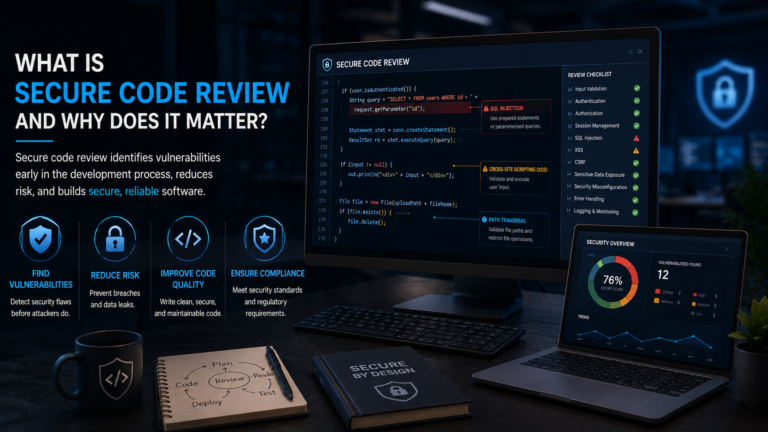
Code review resolves both situations the same way: by reading the actual code in the specific location either tool flagged, with the business and deployment context that neither automated tool has access to. Used this way, SAST and DAST output becomes a prioritization signal that tells a reviewer where to look first, rather than requiring the reviewer to work through an entire codebase without any starting point. Our secure code review post covers this discipline in more depth, and our cybersecurity code review service provides exactly this kind of targeted, context-aware review for organizations already running SAST and DAST and needing the disagreements between them resolved by a human.
When Should You Use SAST vs DAST?
The right question is not when to use one over the other but when each fits into your security testing program and what each is responsible for covering.
Use SAST when:
- You need security feedback during development before deployment is possible
- You want to cover the full codebase, including code paths that are hard to trigger through dynamic testing
- You are looking for code-level issues like hardcoded secrets, cryptographic errors, or insecure dependencies
- You want to integrate security into the developer workflow at the earliest point in the SDLC
Use DAST when:
- The application is deployed, and you need to validate its security from an external perspective
- You need to confirm which vulnerabilities are genuinely exploitable in the deployed environment
- You are testing the application against an external attacker’s view without requiring source code access
- You want to identify runtime-specific vulnerabilities, including authentication weaknesses and missing security headers
Use both when: the application handles sensitive data, is customer-facing, processes payments, or is subject to compliance requirements. That describes most applications worth securing seriously, which is why both belong in the same program rather than as alternatives to each other.
The broader context for where SAST and DAST fit alongside other web application security practices is covered in our post on web application security.
What Are the Limitations Both Share?
SAST and DAST share one important limitation despite their different mechanisms: neither finds the vulnerability classes that require understanding what the application is supposed to do and testing whether it actually does that consistently.
Business logic flaws are the most significant shared limitation. An application that allows a negative order quantity to reduce a customer’s total, a promotional code that can be applied multiple times despite a single-use constraint, or a checkout flow that can be completed out of sequence are all vulnerabilities that require knowing the business rules to test. Neither SAST nor DAST has access to those rules. SAST sees code patterns without business context. DAST sees behavioral responses without knowing what the correct behavior should be.
Complex authorization failures present the same problem. Testing whether a regular user can access an administrator’s data requires knowing which user accounts exist, which resources should be scoped to which user, and what the permission model is supposed to enforce. DAST can attempt some authorization testing but cannot systematically validate a permission model it has never been given. SAST can flag code patterns but cannot evaluate whether the authorization logic is semantically correct for the intended use case.
These shared limitations are why manual penetration testing remains an essential layer alongside automated tooling, not an optional addition. Our web application penetration testing services address the specific vulnerability classes that both SAST and DAST consistently miss, covering authorization validation, business logic testing, and chained vulnerability development that automated approaches cannot reach.
The question of where automated testing ends and manual testing begins is explored in detail in our post on manual vs automated penetration testing.
Frequently Asked Questions
Is SAST or DAST more accurate?
Neither is more accurate in absolute terms, they measure different things. DAST has a lower false positive rate on the vulnerability classes it covers because findings are confirmed through actual runtime interaction rather than code pattern matching. SAST has a higher false positive rate but covers vulnerability classes, particularly code-level issues like hardcoded secrets and cryptographic errors, that DAST cannot assess at all. Accuracy comparisons are only meaningful within the same vulnerability category.
Can SAST find the same vulnerabilities as DAST?
For some categories, yes. Both SAST and DAST can identify SQL injection and cross-site scripting vulnerabilities, but through different mechanisms. SAST finds the code pattern. DAST confirms the runtime exploitability. Each will find some instances the other misses: SAST covers code paths not exercised during dynamic testing, while DAST finds runtime manifestations that static pattern matching does not surface. Using both together produces better coverage than either alone for the vulnerability classes they share.
Does DAST require source code access?
No. DAST operates entirely through the application’s external interface without requiring access to source code, configuration files, or architecture documentation. This is what makes it appropriate for testing third-party applications, testing from an external attacker’s perspective, and testing in environments where source code is not available to the security team.
How does SAST handle third-party libraries and dependencies?
Most SAST tools include dependency scanning as a component, checking imported libraries and packages against known vulnerability databases for versions with published CVEs. This extends SAST coverage to the third-party code that modern applications incorporate rather than limiting analysis to first-party code. Dependency scanning is often one of the highest-value SAST functions for organizations with large numbers of external dependencies, where known vulnerabilities in widely-used libraries can introduce significant risk.
Which should a small team implement first, SAST or DAST?
SAST is typically the easier starting point for small teams because it integrates into the existing development workflow without requiring a deployed environment, produces findings that developers can act on in their normal development context, and addresses vulnerability classes like hardcoded secrets and dependency vulnerabilities that are critical to catch early. DAST should follow once there is a deployed testing environment to run it against. Both are most effective when combined with periodic manual penetration testing that covers the vulnerability classes neither automated approach reaches.
Two Lenses on the Same Application
SAST and DAST are not competing answers to the same question. They are two different lenses on the same application, each revealing what the other cannot see from its position.
SAST sees the code before it runs. It finds the vulnerabilities baked into how the application was written, the secrets left in configuration files, the cryptographic shortcuts that will cause problems at runtime, and the data flow paths that reach unsafe operations without adequate sanitization. It finds these things at the point in the lifecycle where they are cheapest to fix.
DAST sees the application after it runs. It finds the vulnerabilities that only manifest in deployed behavior, confirms which code-level issues are genuinely exploitable in the real environment, and tests the application from the same external position an attacker would occupy. It validates the deployed product rather than the development artifact.
Neither lens is complete. Neither covers the authorization failures, business logic gaps, and chained vulnerabilities that cause the breaches that matter most. A program that uses both alongside manual penetration testing and expert code review addresses the full application security picture rather than the portion any single tool can see.
Contact us to discuss an application security assessment for your organization