What Is Cloud Security Posture Management (CSPM)?

Written By
Sarwat Iftikhar
The majority of cloud security incidents in 2026 do not begin with a sophisticated attack on a vulnerability in cloud provider software. They begin with a misconfiguration. A storage bucket set to public access. An IAM role with administrator permissions attached to a workload that needed read access to one resource. A security group rule allowing inbound traffic from any IP address on a management port, created for convenience and never reviewed again.
These misconfigurations are not rare edge cases. They are the normal output of cloud environments that grow quickly under operational pressure, where provisioning decisions get made faster than security reviews can catch them and where the default settings from cloud providers are not always secure by default. The result is a gap between what an organization believes its cloud security posture looks like and what it actually looks like, and that gap is where the most consistent cloud security risk lives.
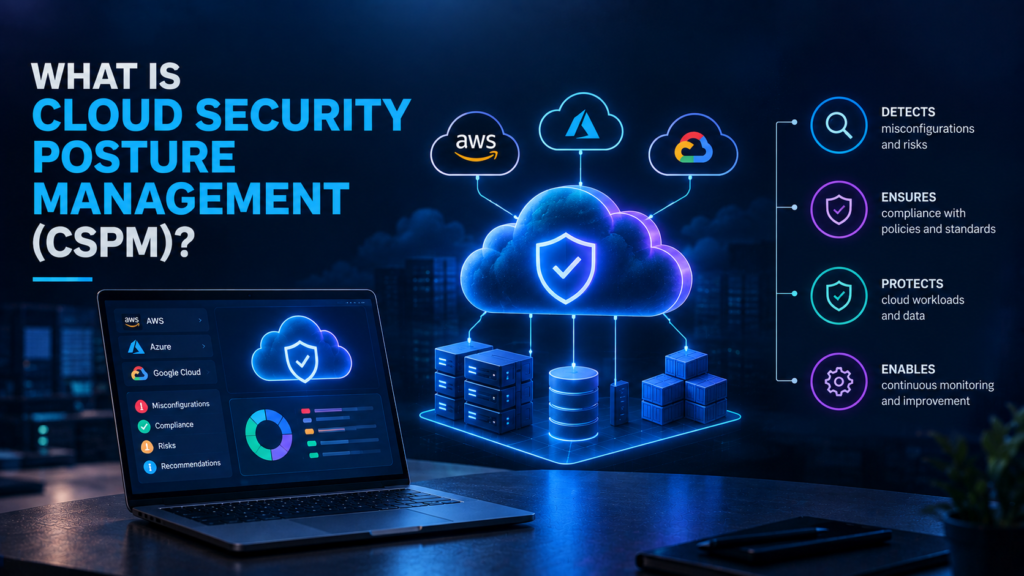
Cloud Security Posture Management is the discipline of closing that gap continuously. CSPM tools automatically monitor cloud infrastructure configurations against security best practices, compliance benchmarks, and organizational policies, identifying misconfigurations in near real-time rather than waiting for a scheduled assessment or an incident to reveal them.
Key Takeaways
- Cloud misconfigurations, not software vulnerabilities in cloud provider infrastructure, account for the majority of cloud security incidents. CSPM addresses this by continuously monitoring configuration state rather than waiting for periodic assessments.
- CSPM covers the full configuration surface of cloud environments: IAM policies, storage permissions, network controls, logging configuration, encryption settings, and cloud service-specific security settings across AWS, Azure, and GCP.
- CSPM is not the same as a cloud security assessment and does not replace active penetration testing. It monitors configuration compliance continuously; assessment and testing validate active exploitability and attack path depth.
- In Bugstrix cloud security engagements, organizations running CSPM tools still consistently have misconfiguration findings that CSPM either did not surface or surfaced but remediation was delayed. The tool is only as effective as the process around it.
- A complete cloud security program combines CSPM for continuous configuration monitoring, cloud security assessments for periodic expert review, and cloud penetration testing for active exploitability validation.
What Is Cloud Security Posture Management?
Cloud Security Posture Management is a category of security tooling and practice that continuously monitors cloud infrastructure configurations across one or more cloud providers, compares that configuration state against security benchmarks and organizational policies, and generates alerts when misconfigurations or compliance gaps are detected. It provides ongoing visibility into whether the cloud environment is configured securely rather than a point-in-time snapshot from a periodic assessment.
The core premise of CSPM is that cloud environments are not static. Resources are provisioned and deprovisioned continuously. Configurations change as services are updated. IAM policies accumulate new permissions. Network rules get added for operational purposes and are never removed. In this environment, a security posture that was acceptable last week may have introduced new risk this week, and waiting for a quarterly assessment or an annual penetration test to discover that is too slow.
CSPM tools connect to cloud provider APIs, continuously pull configuration state across services and accounts, evaluate that state against defined security standards such as CIS Benchmarks, NIST frameworks, and cloud provider security best practices, and surface deviations as alerts or findings. The result is a near real-time picture of configuration risk that gives security teams the visibility to act on misconfigurations quickly rather than discovering them after they have been exploited.
Understanding the broader cloud security landscape that CSPM operates within is useful context before examining its specific capabilities. Our post on cloud security covers the shared responsibility model, the specific risk categories that cloud environments introduce, and how different security disciplines address them.
Why Do Organizations Need CSPM in 2026?
Organizations need CSPM in 2026 because cloud environments change faster than any manual process can monitor, and the misconfiguration risk that accumulates in those changes is the most consistently exploited category of cloud vulnerability. Security teams that rely on periodic assessments to maintain cloud configuration hygiene are operating with visibility that is weeks or months out of date in environments that change daily.
The scale of the problem is structural. Modern cloud environments are built on hundreds of services across multiple accounts and regions. Each service has its own configuration surface. Each account accumulates IAM roles, policies, and trust relationships over time. Network security groups, storage bucket permissions, database access controls, and management interface exposure all change as teams provision resources for new workloads, modify existing ones, and deprovision infrastructure that is no longer needed but whose configuration artifacts may persist.
Manual review of this configuration surface is not feasible at any meaningful frequency. A cloud security team that could conduct a complete manual review of every IAM policy, every storage bucket permission, every security group rule, and every service configuration across a multi-account AWS environment would need to repeat that review continuously to keep pace with the rate of change. CSPM automates that monitoring so the human security team can focus on evaluating and responding to the alerts it generates rather than on the raw configuration data collection.
The risk consequence of missed misconfigurations is also significant. Publicly accessible storage containing sensitive data, over-permissioned service accounts, and management interfaces exposed to the internet create real, exploitable risk from the moment they are created. CSPM’s value is not just in finding these issues. It is in finding them quickly enough that the window of exposure is minimized.
How Does CSPM Work?
CSPM works by connecting to cloud provider APIs with read-only access, continuously pulling configuration data across all in-scope accounts, services, and regions, evaluating that data against a defined set of security rules and compliance benchmarks, and generating prioritized alerts when the configuration state deviates from the expected secure baseline.
CSPM runs this four-stage cycle continuously rather than periodically, providing near real-time visibility into configuration changes that introduce new risk between scheduled assessment cycles:
| Stage | What Happens |
| 01 · Connect | Read-only API access to cloud accounts across all regions |
| 02 · Collect | Continuously pull configuration state from IAM, storage, network, services |
| 03 · Evaluate | Compare against CIS Benchmarks, NIST, SOC 2, custom policies |
| 04 · Alert and Act | Generate prioritized alerts, route to security team, track remediation |
Source: Bugstrix cloud security framework, 2026 | Process repeats continuously
Stage 1: Connect. The CSPM tool establishes read-only API connections to cloud accounts across all providers and regions in scope. Read-only access is sufficient for configuration monitoring and does not require the elevated permissions that active security testing would need. Connection is maintained continuously so configuration changes are detected as they occur rather than at scheduled pull intervals.
Stage 2: Collect. Configuration data is pulled from cloud provider APIs covering every relevant service: IAM policies and role assignments, storage bucket and object access configurations, network security groups and firewall rules, virtual private cloud configurations, logging and monitoring enablement, encryption settings, database access controls, and cloud service-specific configuration parameters. The breadth of collection is what gives CSPM visibility across the full configuration surface.
Stage 3: Evaluate. Collected configuration data is evaluated against a rule set that typically includes cloud provider security benchmarks such as the CIS AWS Foundations Benchmark, industry standards such as NIST SP 800-53, compliance framework mappings for SOC 2, ISO 27001, PCI DSS, and HIPAA, and organizational custom policies that reflect security requirements specific to the environment. Each configuration element is assessed against the applicable rules and findings are generated where the configuration deviates from the expected secure state.
Stage 4: Alert and act. Findings are prioritized by severity and business impact, routed to the appropriate team through configured notification channels, and tracked through remediation. Severity prioritization matters because most cloud environments generate significant CSPM finding volumes and not all findings represent equal risk. High-severity findings affecting broadly accessible resources warrant immediate attention. Low-severity informational findings require a different response cadence.
What Does CSPM Monitor and Detect?
CSPM monitors the full configuration surface of cloud environments across seven primary domains: identity and access management, data storage and exposure, network security controls, logging and monitoring coverage, encryption configuration, cloud service-specific settings, and compliance posture against applicable standards. Each domain addresses a distinct category of misconfiguration risk.
Identity and access management is the highest-priority monitoring domain. IAM misconfigurations, including overly permissive roles, unused elevated accounts, service accounts with administrator access, and missing multi-factor authentication on privileged accounts, are the most consistently exploited category of cloud configuration weakness. CSPM continuously evaluates IAM policy combinations for effective permission scope, identifying cases where the combination of policies attached to a principal creates broader access than any individual policy alone would suggest.
Data storage and exposure monitoring checks all storage services, including object storage buckets, database instances, data lakes, and file storage services, for unintended public access, insufficient access restrictions, and missing encryption. Publicly accessible storage containing sensitive data is one of the most common findings in cloud environments and one of the most impactful from a data breach perspective.
Network security controls monitoring evaluates security group rules, network ACLs, VPC configurations, and firewall policies for rules that allow broader access than the workload requires. Unrestricted inbound rules on management ports such as SSH and RDP, security group rules that allow access from any IP address, and VPC configurations that do not adequately isolate sensitive workloads all appear in CSPM findings.
Logging and monitoring coverage verifies that audit logging is enabled across cloud services and accounts, that logs are retained for the required period, and that alerting is configured for security-relevant events. Gaps in logging are critical findings not because they create direct exploit risk, but because they eliminate the forensic visibility needed to detect and investigate incidents.
Encryption configuration confirms that data at rest and in transit is encrypted appropriately, that key management meets security standards, and that any storage or transmission without encryption is intentional rather than a configuration oversight.
How Is CSPM Different from a Cloud Security Assessment?
CSPM and a cloud security assessment both address cloud configuration security but operate on fundamentally different cadences and through different methodologies. CSPM provides continuous automated configuration monitoring. A cloud security assessment is a periodic, expert-led evaluation that combines automated tooling with manual review and provides depth that continuous monitoring alone cannot achieve.
The distinction matters practically because the two approaches find different things and serve different purposes. CSPM excels at catching configuration drift between assessment cycles: the security group rule added last Tuesday, the storage bucket permission changed last month, the new IAM role provisioned with broader access than necessary. Its breadth and continuity give it visibility across the entire configuration surface at all times.
A cloud security assessment provides what CSPM cannot: expert analysis of complex configuration combinations that automated rules do not evaluate effectively, manual review of IAM policy interactions that produce unintended effective permissions across multiple attached policies, evaluation of multi-account trust relationships and cross-account access pathways, and the contextual judgment that distinguishes a genuinely misconfigured setting from one that is intentional given the specific deployment architecture.
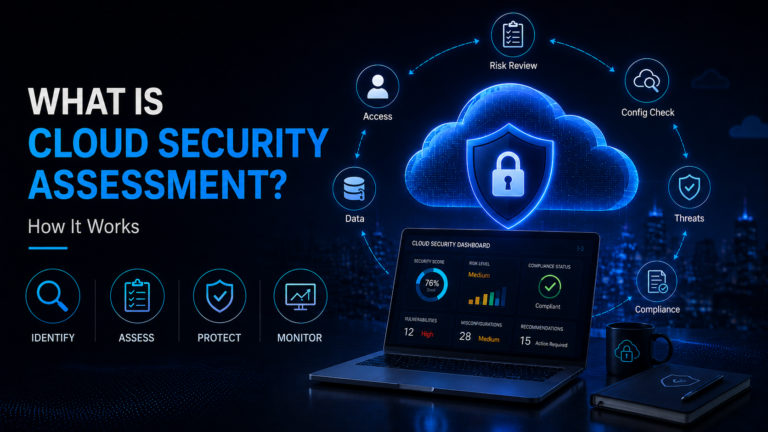
Neither replaces the other. CSPM maintains continuous baseline visibility. Cloud security assessments validate and deepen that visibility periodically through expert review that adds the context automated rules cannot supply. Our post on cloud security assessment covers the assessment methodology in detail, including how the manual review phase finds the things CSPM misses.
Which Cloud Platforms Does CSPM Cover?
CSPM covers AWS, Microsoft Azure, and Google Cloud Platform as the three primary public cloud providers, with coverage extending to multi-cloud environments where organizations run workloads across more than one provider. Each platform has distinct service architectures, IAM models, and configuration surfaces that require platform-specific rule sets rather than generic cloud security controls.
AWS coverage encompasses the broadest service portfolio of any cloud provider, including IAM roles and policies, S3 bucket permissions, Security Groups and Network ACLs, CloudTrail and CloudWatch configuration, KMS key management, EC2 instance configurations, and the security posture of managed services including RDS, Lambda, EKS, and API Gateway. AWS-specific benchmarks including the CIS AWS Foundations Benchmark and AWS Security Hub standards form the primary rule framework for AWS environments.
Azure coverage focuses on Azure Active Directory configurations, role-based access control assignments, Azure Blob Storage and container permissions, Network Security Group rules, Microsoft Defender for Cloud integration, Key Vault access policies, and the security configuration of Azure-native services including AKS, Azure SQL, and Azure Functions. The Microsoft Cloud Security Benchmark and Azure Security Center recommendations provide the primary standards framework.
GCP coverage addresses IAM bindings, service account configurations, Cloud Storage bucket permissions, Firewall Rules and VPC Service Controls, Cloud Audit Logs configuration, Cloud KMS key management, and the security posture of GCP-native services including GKE, Cloud Run, and BigQuery.
Multi-cloud environments introduce additional CSPM considerations around consistent policy application across providers, cross-cloud identity federation configurations, and unified compliance reporting that aggregates findings from multiple providers into a coherent posture view.
How Does CSPM Help With Compliance?
CSPM supports compliance with major security frameworks by continuously monitoring whether the cloud configuration controls required by those frameworks are in place and functioning, providing the automated evidence collection and compliance posture tracking that compliance auditors and security leadership require for cloud-heavy environments.
For SOC 2, CSPM generates continuous evidence that configuration controls under CC6.1 (logical access controls) and CC7.1 (system operations) are being monitored and maintained. It provides an audit trail of configuration state over the observation period that supports CC4.1 monitoring activity evidence. It does not, however, replace the penetration testing requirement that SOC 2 auditors expect as evidence of active security testing. Our post on SOC 2 requires penetration testing explains that distinction, which is relevant for organizations that assume CSPM compliance evidence covers their full SOC 2 obligation.
For PCI DSS, CSPM addresses the continuous monitoring requirements under Requirement 11.6 and 12.3 and supports the change detection capabilities required under the standard. Cloud environments within the Cardholder Data Environment scope still require the annual internal and external penetration testing mandated by Requirement 11.4 separately from CSPM coverage.
For ISO 27001, CSPM supports Annex A.8.8 (Management of Technical Vulnerabilities) by providing continuous identification of configuration vulnerabilities, and A.8.9 (Configuration Management) by maintaining visibility into configuration state across the cloud environment.
The compliance value of CSPM is in automation and continuity. Manual evidence collection across cloud accounts for compliance purposes is time-consuming and produces point-in-time evidence. CSPM generates continuous, timestamped evidence of configuration monitoring that is more valuable to auditors and more sustainable operationally than manual approaches.
What Are the Limitations of CSPM?
CSPM has important limitations that organizations need to understand before relying on it as their primary cloud security control. The most significant limitation is that CSPM monitors configuration state but cannot assess whether a misconfiguration is actively exploitable in the specific deployment context or what an attacker could realistically accomplish by exploiting it.
A CSPM tool that detects a publicly accessible storage bucket generates an alert. It does not determine whether that bucket contains sensitive data, whether it has been accessed by unauthorized parties, whether an attacker could chain that access with another finding to escalate to a more serious compromise, or whether the public access was intentional for a legitimate reason. Those determinations require human analysis and, in many cases, active testing.
The specific limitations that matter most for security programs:
CSPM does not validate active exploitability. Configuration findings represent potential risk. Whether that potential risk is genuinely exploitable in the specific environment, given the surrounding compensating controls and actual deployment configuration, requires validation through active testing rather than configuration comparison.
CSPM rules miss complex IAM interactions. IAM policy combinations that create unintended effective permissions through the interaction of multiple attached policies, resource-based policies, and service control policies require human analysis to evaluate correctly. Automated rules evaluate policies individually and often miss the combined effect of multiple policies working together.
CSPM generates alert volume that requires effective triage. In actively developed cloud environments, CSPM findings can accumulate faster than remediation teams can clear them. Without effective severity prioritization and triage processes, high-severity findings can be delayed while teams work through lower-priority alerts.
CSPM does not replace periodic expert review or active testing. The expert analysis that a cloud security assessment provides and the active exploitation evidence that cloud penetration testing generates are not available from CSPM. Both remain essential components of a complete cloud security program.
How Does CSPM Fit Into a Complete Cloud Security Program?
CSPM fits into a complete cloud security program as the continuous monitoring layer that maintains visibility into configuration state between the periodic expert assessments and active security tests that validate exploitability and attack path depth. It is the always-on foundation that makes periodic deep-dive testing more efficient and more focused.
The four layers of a complete cloud security program work together as follows:
CSPM runs continuously, detecting configuration drift and compliance gaps across the full cloud environment. It maintains the baseline visibility that keeps the security team informed between assessment cycles and generates the compliance evidence that audit programs require.
Cloud security assessments provide periodic expert review that validates CSPM findings in context, identifies complex configuration issues that CSPM rules miss, and produces the depth of analysis that manual review adds to automated monitoring. The assessment cadence depends on how frequently the cloud environment changes and what compliance frameworks apply.
Cloud penetration testing actively attempts to exploit the vulnerabilities and misconfigurations identified through CSPM and assessment, demonstrating the realistic attack paths and business impact that configuration-level analysis cannot produce. It provides the exploitation evidence that compliance frameworks specifically require and that security leadership needs to make informed risk decisions. Our cloud penetration testing services are structured to work alongside CSPM programs, focusing active testing effort on the highest-risk findings that continuous monitoring has already identified.
Attack surface management continuously discovers all cloud assets across accounts and regions, ensuring the CSPM scope accurately reflects the full cloud environment rather than only the assets the security team knows about. Unknown assets outside the CSPM scope are the ones most likely to contain misconfiguration risk that monitoring does not reach. Our attack surface management service provides that continuous discovery layer alongside cloud configuration monitoring.
The interaction between these layers is what produces a cloud security program that neither static periodic testing nor continuous automated monitoring achieves alone. CSPM finds configuration drift quickly. Assessment adds contextual depth. Penetration testing validates real-world exploitability. Attack surface management ensures the scope is complete.
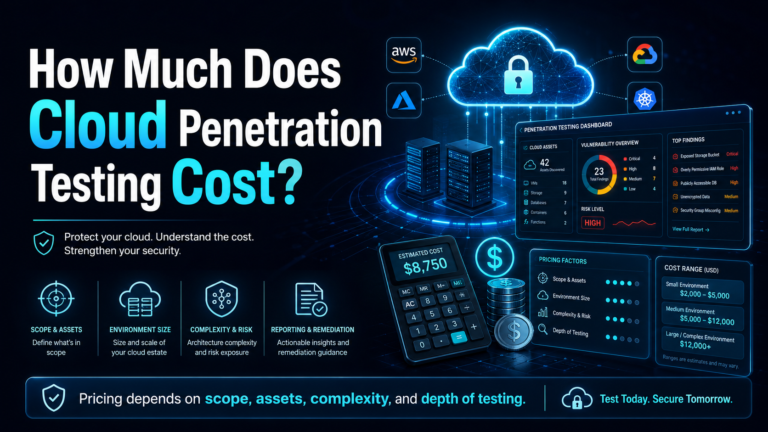
For organizations evaluating the broader landscape of cloud security testing investments, our post on how much cloud penetration testing costs in 2026 covers pricing across different cloud security assessment and testing engagement types.
Frequently Asked Questions
Is CSPM the same as a Cloud Security Assessment?
No. CSPM is continuous automated configuration monitoring. A cloud security assessment is a periodic, expert-led evaluation that combines automated tooling with manual review. CSPM catches configuration drift in near real-time. A cloud security assessment provides the depth of expert analysis, complex IAM evaluation, and deployment context that automated monitoring cannot supply. Both are needed in a complete cloud security program, and neither substitutes for the other.
Does CSPM replace penetration testing for cloud environments?
No. CSPM monitors configuration state but does not validate whether identified misconfigurations are actively exploitable or demonstrate what an attacker could realistically accomplish by exploiting them. Cloud penetration testing provides that active exploitability validation. Most compliance frameworks including PCI DSS and SOC 2 require penetration testing evidence separately from configuration monitoring evidence, and CSPM compliance evidence does not satisfy that requirement.
Can CSPM work across multiple cloud providers simultaneously?
Yes. Most CSPM platforms support multi-cloud environments covering AWS, Azure, and GCP simultaneously, with provider-specific rule sets for each platform and consolidated reporting that provides a unified compliance posture view across the full cloud environment. Multi-cloud environments require provider-specific expertise in the rule sets applied to each platform rather than generic cross-cloud rules that may not reflect the security model accurately.
How much alert volume should we expect from CSPM?
Alert volume depends on the maturity of the cloud environment’s existing security configuration and the breadth of the rules applied. Organizations deploying CSPM in cloud environments that have not been previously hardened typically see substantial initial finding volumes as existing configuration debt is surfaced. After an initial remediation phase, ongoing volume reflects the rate of new configuration drift. Effective CSPM programs implement severity-based triage that directs immediate attention to critical and high findings while lower-severity alerts are addressed in planned remediation cycles.
What is the relationship between CSPM and attack surface management?
Attack surface management continuously discovers all exposed assets across the cloud environment, including assets that may not be in the CSPM monitoring scope. CSPM monitors the configuration security of known, in-scope assets. The two capabilities complement each other: attack surface management ensures the CSPM scope is complete by identifying unknown or forgotten cloud assets, while CSPM monitors the configuration quality of everything within scope. Assets outside CSPM scope because they were unknown represent the highest-risk blind spots in a cloud security program.
The Gap Between What CSPM Shows and What Security Requires
CSPM is a necessary component of cloud security in 2026. Cloud environments are too dynamic, too broad, and too configuration-sensitive for organizations to maintain security posture visibility through periodic manual assessment alone. The continuous monitoring that CSPM provides is not optional for cloud-heavy organizations. It is the baseline.
What CSPM is not is sufficient on its own. The configuration compliance picture it produces tells you what the cloud environment is configured to do. It does not tell you what an attacker can do with that configuration, how misconfiguration findings chain together into realistic attack paths, or whether the complex IAM relationships across accounts create access pathways that no individual policy review would reveal. Those questions require assessment depth and active testing that CSPM cannot supply.
Organizations at Bugstrix that handle cloud security most effectively are the ones that treat CSPM as the monitoring layer it is designed to be, and build the periodic expert assessment and active testing program on top of it. The monitoring maintains visibility. The assessment adds depth. The testing validates reality. Together, they produce a cloud security posture that reflects how the environment actually behaves under adversarial conditions rather than how its configuration appears in a monitoring dashboard.
Contact us to discuss building a complete cloud security program for your environment