What Is a Vulnerability Disclosure Program (VDP)?

Written By
Sarwat Iftikhar

Security researchers discover vulnerabilities in organizational systems every day. Some of those researchers have no formal channel to report what they found. Without one, they face an uncomfortable set of choices: contact the organization informally and risk being ignored or threatened with legal action, disclose the vulnerability publicly and risk enabling attackers before it is fixed, or say nothing and leave the vulnerability open.
A Vulnerability Disclosure Program eliminates that problem by creating a formal, published channel through which security researchers can safely report vulnerabilities they discover in an organization’s systems. It defines the scope of what can be tested, establishes legal protections for researchers who act in good faith, sets expectations for how reports will be handled, and outlines the organization’s commitment to respond and remediate.
For organizations, a VDP provides something equally valuable: a continuous stream of external security intelligence from researchers who are motivated to find real vulnerabilities and willing to report them rather than exploit them. In 2026, with external researchers actively testing internet-facing systems regardless of whether an organization has formally invited them to, a VDP determines whether those findings reach your security team or somewhere else.
Key Takeaways
- A VDP creates a formal, published channel for security researchers to safely report vulnerabilities they discover in an organization’s systems, without fear of legal repercussions for good-faith research.
- Unlike a bug bounty program, a VDP does not pay financial rewards for findings. It provides a structured, legal reporting channel and a commitment to respond and remediate.
- In Bugstrix security assessments, organizations with a published VDP consistently receive more actionable external vulnerability intelligence than those without one, because researchers have a defined path to report findings responsibly.
- A VDP is not a substitute for internal security testing. It is a complementary layer that surfaces vulnerabilities from the external researcher community that internal programs may not cover.
- The most important element of a VDP is not the policy itself but the triage and response process behind it. A VDP that generates reports that are ignored or responded to slowly loses researcher trust and stops receiving actionable submissions.
What Is a Vulnerability Disclosure Program?
A Vulnerability Disclosure Program is a formal organizational policy that defines how security researchers can report vulnerabilities they discover in the organization’s systems, what protections they receive for good-faith research, what is in and out of scope for testing and reporting, and how the organization will respond to valid submissions.
The core function of a VDP is to create a safe, clearly defined channel for responsible disclosure. Without one, researchers who discover a vulnerability in an organization’s systems operate in legal and procedural ambiguity. Security research that involves accessing systems without explicit permission can technically violate laws in many jurisdictions regardless of the researcher’s intent, which means researchers who want to act responsibly have no guaranteed safe path to do so.
A VDP resolves this by explicitly inviting responsible research within a defined scope, committing to a safe harbor that protects good-faith researchers from legal action, and providing a specific submission process with defined response timelines. The existence of that framework changes the researcher’s position from potentially unauthorized access to explicitly invited participation in the organization’s security program.
The relationship between a VDP and a bug bounty program is a common source of confusion. A bug bounty program is a VDP with financial rewards attached. A VDP without financial rewards provides all the structural and legal benefits of a disclosure program without the budget commitment of paid bounties. Many organizations begin with a VDP and add financial rewards later as the program matures, while others operate VDPs without ever moving to a paid model.
Why Does a Business Need a Vulnerability Disclosure Program?
A business needs a VDP because external researchers are already testing its systems whether or not a formal program exists, and without one, the organization has no structured way to receive, triage, or act on what those researchers find. The absence of a VDP does not prevent external research. It only determines where the findings go.
The external attack surface of any organization with an internet presence is being continuously probed by a wide range of actors, from automated scanning to deliberate manual research. Within that population are genuine security researchers who find real vulnerabilities and prefer to report them responsibly rather than exploit them. Without a VDP, those researchers either find an informal contact point such as a generic security email address, post publicly out of frustration with having no formal channel, or abandon the report entirely. In each scenario, the organization either receives the finding through an unstructured channel it may not monitor effectively, or loses the finding altogether while the vulnerability remains open.
The business case extends beyond just receiving reports. Organizations with published VDPs signal to the researcher community that they take security seriously and engage constructively with external findings. That signal tends to attract more sophisticated, high-quality research than organizations without one. It also provides a defense in legal and regulatory contexts, demonstrating that the organization had a functioning mechanism for receiving and acting on vulnerability reports.
Regulatory expectations around vulnerability disclosure are also tightening. The EU’s NIS2 Directive and DORA both reference coordinated vulnerability disclosure as part of a mature security posture for covered entities. In the United States, federal agencies are required to have VDPs, and that requirement is progressively influencing expectations for contractors and regulated industries. Building a VDP now positions the organization ahead of disclosure requirements that are increasingly likely to affect mid-market and enterprise organizations in regulated sectors.
What Is the Difference Between a VDP and a Bug Bounty Program?
A VDP and a bug bounty program both create structured channels for external security researchers to report vulnerabilities, but they differ in one fundamental respect: a bug bounty program pays financial rewards for valid findings, while a VDP does not. Every bug bounty program is a VDP with financial incentives added. Not every VDP is a bug bounty program.
The practical difference in researcher behavior is significant. Bug bounty programs attract financially motivated researchers who invest significant time and expertise specifically because there is economic return for finding high-severity vulnerabilities. VDPs attract researchers who are primarily motivated by responsible disclosure, professional development, or organizational affiliation rather than financial reward. This produces different finding profiles: bug bounty programs generate higher volumes of reports, including more trivial findings, while VDPs tend to generate lower volumes of more carefully selected and documented reports.
For organizations deciding between the two, the VDP is almost always the right starting point. It establishes the policy, the legal framework, the triage process, and the response commitment that a bug bounty program would also require, without the financial commitment and volume management challenges that bounty payments introduce. An organization that has not built an effective VDP response process is not ready to manage a bug bounty program, because the problems of a poorly run VDP are magnified significantly when financial incentives increase researcher volume.
Our post on bug bounty program covers the bug bounty model in detail, which provides useful context for understanding where the two programs differ and when moving from a VDP to a paid model makes sense.
What Should a VDP Policy Include?
A VDP policy must include six core elements to function as a genuine program rather than a legal document that researchers do not trust: a defined scope, a safe harbor statement, a submission process, response timeline commitments, remediation commitments, and disclosure guidelines. Each element addresses a different researcher concern, and missing any one of them reduces the program’s effectiveness.
Scope. The scope defines which systems, domains, applications, and services are within the program. Researchers need to know exactly what they can test without exceeding the boundaries of authorized research. The scope should be as broad as practically manageable, covering the full external attack surface rather than limiting to a single product, because researchers will test what they can reach regardless of what the policy covers. Systems explicitly excluded from scope should be listed separately with the reason for exclusion.
Safe harbor. The safe harbor is the legal protection component that distinguishes a formal VDP from a simple contact form. It commits the organization not to pursue legal action against researchers who act in good faith within the defined scope, and defines what good faith means in specific behavioral terms: not accessing data beyond what is needed to demonstrate the vulnerability, not disrupting services, not disclosing findings publicly before remediation. A weak or vague safe harbor reduces researcher participation because the legal risk of submitting is unclear.
Submission process. The submission process defines how reports are submitted, what information a valid report should contain, and what the researcher should expect after submission. A clear template that requests severity assessment, reproduction steps, and supporting evidence produces more actionable reports than an open-ended form. Many organizations use dedicated security disclosure platforms or a security-specific email address rather than general support channels.
Response timelines. Response timelines commit the organization to acknowledge reports within a defined period, typically 24 to 72 hours, confirm validity or rejection within a defined period, and provide regular status updates throughout the remediation process. Unrealistic timelines damage trust. Realistic timelines that are actually met build the program’s reputation in the researcher community.
Remediation commitments. The remediation commitment defines the organization’s intent to address valid findings within a timeframe proportional to severity. Critical findings warrant faster remediation timelines than informational findings. Transparency about remediation progress, even without sharing sensitive implementation details, maintains researcher engagement.
Disclosure guidelines. Disclosure guidelines address when and how findings may be publicly disclosed. Most VDPs request a coordinated disclosure period, typically 90 days, during which the researcher agrees not to publish the finding publicly while the organization remediates. After the period expires, the researcher is free to publish. Clear guidelines prevent disputes about public disclosure timing that damage both the organization and the researcher relationship.
How Does a Vulnerability Disclosure Program Work in Practice?
A VDP works through a structured cycle from report receipt through validation, remediation, and closure. The effectiveness of the program depends on the quality of this process, not just the policy published externally. A policy with a well-defined scope and strong safe harbor that routes submissions to an inbox nobody monitors is not a functioning VDP.
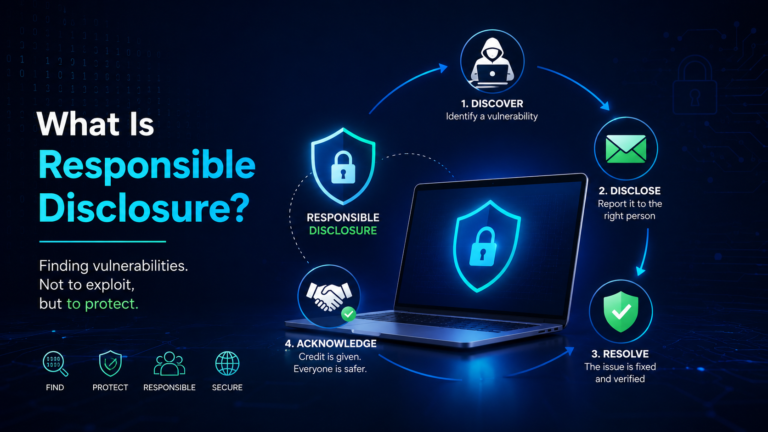
Step 1: Report submission. A researcher discovers a potential vulnerability in a system within the defined scope, completes the organization’s submission form or emails the designated security contact, and provides the reproduction steps, evidence, and severity assessment requested by the policy.
Step 2: Acknowledgment. The security team acknowledges receipt within the timeframe committed in the policy. This acknowledgment is critical for researcher trust. A researcher who receives no acknowledgment has no way to know whether their submission was received, and will often either resubmit or escalate to public disclosure out of concern that the organization is not responding.
Step 3: Triage and validation. The security team evaluates the submission to determine whether it represents a genuine vulnerability, whether it falls within the defined scope, and what the correct severity assessment is. This step requires security expertise. A well-organized VDP has a defined triage process with assigned owners and escalation paths for high-severity findings rather than routing all submissions to a general security inbox.
Step 4: Communication. Valid findings are communicated back to the researcher with the organization’s severity assessment and a timeline for remediation. Invalid findings are explained clearly, not dismissed without justification. Researchers who understand why a submission was not accepted are more likely to submit higher-quality reports in future.
Step 5: Remediation. The security team remediates confirmed findings according to the severity-based timeline committed in the policy. Tracking and prioritizing VDP-sourced findings alongside internally discovered vulnerabilities requires that VDP submissions feed into the same vulnerability management process rather than a separate, lower-priority queue.
Step 6: Closure and optional disclosure. Once remediated, the finding is closed and the researcher is notified. If the researcher requests public disclosure after the coordinated period, the organization acknowledges the finding was resolved and may provide a CVE assignment where applicable. Many organizations acknowledge researchers publicly in security advisories, which serves as both recognition for the researcher and a demonstration of the program’s value.
What Is the Legal Basis for a VDP?
The legal basis for a VDP is the explicit authorization it provides to researchers who operate within its defined scope and good-faith requirements. Security research that involves accessing systems without explicit authorization can violate computer fraud and unauthorized access laws in many jurisdictions regardless of the researcher’s intent. A VDP provides that authorization explicitly within defined parameters, creating a legal safe harbor for good-faith research.
The legal protections work in both directions. Researchers who stay within scope and act in good faith are protected by the organization’s published safe harbor commitment. The organization benefits from a legal framework that distinguishes authorized good-faith research from unauthorized malicious access, which is relevant both for protecting researchers who find vulnerabilities and for pursuing legal action against actors who clearly exceed the defined boundaries with malicious intent.
The specificity of the safe harbor matters significantly. A generic statement saying the organization “will not pursue legal action against security researchers” is less protective than a detailed statement that defines good-faith behavior specifically, commits to a defined process for resolving disputes about whether research was within scope, and explicitly names the relevant legal provisions the organization will not invoke against good-faith researchers. Legal counsel familiar with security research disclosure should review the safe harbor language before the VDP is published.
How Does a VDP Fit Alongside Internal Security Testing?
A VDP complements internal security testing by providing external researcher coverage of the attack surface between internal testing cycles, covering areas and techniques that internal testing programs may not systematically address. It is not a substitute for structured internal security testing. The two serve different purposes and provide different types of findings.
Internal security testing, including penetration testing and vulnerability assessments, is structured, scoped, and conducted by practitioners using defined methodologies over a fixed timeframe. It provides systematic coverage of the highest-priority attack surface and produces audit-ready evidence that compliance frameworks specifically require. Our post on vulnerability assessment vs penetration testing explains the distinction between the two internal testing approaches and where each belongs in a security program.
A VDP provides continuous external research coverage between those structured test cycles. An external researcher may spend weeks investigating a specific component of the attack surface using techniques and creativity that an internal tester with a fixed engagement window and defined scope might not apply. The finding that emerges from that extended, focused research may be something the internal program would not have prioritized within its scope constraints.
The combination is more effective than either alone. Internal testing provides systematic, methodology-driven coverage with audit-ready evidence. The VDP provides continuous external researcher attention that reflects how real attackers approach the attack surface over extended periods. Our vulnerability assessment services and web application penetration testing services form the structured internal testing foundation that a VDP builds on top of rather than replacing.
For organizations that want ongoing external testing coverage alongside their VDP, our continuous penetration testing services provide the structured, repeatable testing that maintains coverage between annual assessments, working alongside rather than instead of an external disclosure program.
How Does a VDP Relate to Vulnerability Management?
A VDP generates findings that need to be triaged, prioritized, tracked, and remediated through the same vulnerability management processes that handle internally discovered issues. The mistake many organizations make when launching a VDP is treating it as a separate channel with a separate workflow rather than integrating it into the existing vulnerability management program.
When VDP submissions route to a separate queue with lower priority than internally discovered findings, response times suffer, remediation timelines extend, and researcher trust degrades. When VDP submissions are treated as a peer input to the same vulnerability management process that handles penetration test findings and vulnerability scan results, the program operates more efficiently, and the security team develops better habits around disclosure management.
The integration specifically requires: a defined owner for VDP triage, clear escalation paths for high-severity findings, a tracking mechanism that reflects VDP findings in the same vulnerability database as internally discovered issues, and reporting that includes VDP metrics alongside internal security testing metrics.
Our post on vulnerability management covers the vulnerability management lifecycle in detail, which is the foundational process that VDP findings need to feed into. Our attack surface management service provides the continuous external visibility that makes the integration between VDP findings and internal attack surface management more effective.
How Do You Build and Launch a VDP?
Building and launching a VDP requires five sequential steps: defining scope, drafting the policy, establishing the triage and response process, choosing a submission channel, and publishing the policy. The policy is the external-facing deliverable. The process behind it is what determines whether the program actually works.
Step 1: Define scope. Identify which systems and domains the organization can responsibly accept and respond to reports about. The scope should cover the complete external attack surface rather than a limited subset, but should exclude systems where unsolicited testing could cause harm or where the organization has no ability to remediate findings, such as third-party services the organization does not control.
Step 2: Draft the policy. Write the six core policy elements: scope, safe harbor, submission process, response timelines, remediation commitment, and disclosure guidelines. Have the safe harbor language reviewed by legal counsel before publication. Benchmark the policy against published VDPs from comparable organizations to ensure the commitments are realistic and the safe harbor is comprehensive.
Step 3: Establish the triage and response process. Define who owns VDP submissions, what the escalation path is for high-severity findings, how submissions will be tracked, and how researcher communications will be managed. This process needs to be operational before the policy is published. Publishing a VDP and then scrambling to build a triage process after the first submissions arrive produces poor response times that damage the program’s reputation immediately.
Step 4: Choose a submission channel. Options range from a security-specific email address to a dedicated web form to a third-party disclosure platform. Dedicated platforms provide structured submission templates, automated acknowledgments, and triage workflows that are significantly more efficient than email management for programs that receive regular submissions.
Step 5: Publish and promote. Publish the policy at a standard location such as the organization’s website security page and a dedicated security.txt file at the standardized path on all domains. The security.txt file is a widely adopted standard that allows automated tools and researchers to discover the policy without manually searching the website. Once published, the VDP should be referenced in security documentation, vendor questionnaire responses, and compliance evidence packages.
Who Should Set Up a VDP?
Any organization with an internet-facing attack surface that receives security-related inquiries through unstructured channels, that participates in enterprise sales processes involving security questionnaires, or that operates in a sector where regulatory expectations around vulnerability disclosure are tightening should set up a VDP. That description applies to most mid-market and enterprise organizations in 2026.
The minimum organizational readiness required to run a VDP effectively is: at least one person who can triage security vulnerability reports with technical understanding, a defined vulnerability management process that VDP findings can feed into, legal counsel available to review the safe harbor language, and a timeline commitment the organization can actually meet. A VDP that acknowledges submissions but consistently fails to provide status updates or takes months to remediate reported findings actively damages the organization’s security posture by discouraging future responsible disclosure.
For small businesses evaluating whether a VDP fits within their security program alongside other investments, our post on how much a small business should spend on cybersecurity provides context for prioritizing security investments proportionate to organizational size and risk.
Frequently Asked Questions
Is a VDP required by any compliance framework?
No compliance framework universally mandates a VDP at this stage, but several regulatory environments reference coordinated vulnerability disclosure as a component of a mature security posture. NIS2 and DORA in the EU reference disclosure programs for covered entities. US federal agencies are required to have VDPs, and that requirement influences contractor expectations. ISO 27001:2022 includes coordinated vulnerability disclosure as an Annex A control under A.8.8. The expectation is growing and is likely to become more formal in regulated sectors over the next several years.
How is a VDP different from a contact form on a security page?
A contact form provides a submission mechanism without a policy. A VDP provides a defined scope, a legal safe harbor, specific response timeline commitments, and a public remediation commitment. The difference is not in the submission channel but in the program structure around it. A researcher who submits through a contact form has no clarity on whether their submission will be evaluated, what legal protections apply to their research, or how long remediation will take. A VDP answers all of those questions explicitly.
How much does running a VDP cost?
A VDP has no direct per-finding cost in the way a bug bounty program does. The costs are operational: staff time for triage and response, potentially a platform fee for a dedicated disclosure management tool, and legal counsel time to review the policy. For organizations with an existing security operations function that handles vulnerability tracking, the incremental cost of adding a VDP is primarily the policy development effort and the triage time for submissions. Bug bounty programs add the variable cost of bounty payments on top of these operational costs.
What happens if a researcher discloses a vulnerability publicly before we remediate?
Most researchers who submit through a VDP respect the coordinated disclosure period specified in the policy. When they do not, the organization’s response should focus on accelerating remediation rather than legal threats, which would damage the organization’s reputation in the researcher community and discourage future responsible disclosure. The coordinated disclosure norm in the security research community is well established, and researchers who regularly exceed disclosure timelines without notification are not considered to be acting in good faith.
Should a VDP scope include all internet-facing systems?
Yes, where practical. A narrow scope that excludes significant parts of the external attack surface means that researchers who find vulnerabilities in excluded systems have no legitimate reporting channel, which effectively pushes those findings toward public disclosure or abandonment. The scope should cover everything the organization can responsibly accept and act on reports about. Systems genuinely excluded for operational reasons should be listed explicitly in the policy, so researchers understand why they are out of scope.
The Channel Your Security Program Is Missing
Every organization with an internet presence has security researchers examining its systems. Some of those researchers are well-intentioned and would report what they find if given a clear, safe way to do so. Without a VDP, there is no clear, safe way. The finding either reaches the organization through an informal, unstructured channel, goes unreported, or ends up public before it is fixed.
A VDP resolves that structural gap with a relatively low operational investment. It creates the formal channel, establishes the legal protections, sets the expectations, and builds the organizational habit of engaging constructively with external security intelligence rather than being surprised by it.
The security programs that benefit most from VDPs are not those that treat them as a compliance document to be published and forgotten. They are the ones that treat them as an ongoing intelligence channel, where external researchers are a valued part of the security program rather than a liability to be managed, and where submissions are handled with the same seriousness as internally discovered vulnerabilities.