What Is Red Teaming and How Does It Work?

Written By
Sarwat Iftikhar
Most security testing answers one question: do vulnerabilities exist in this environment? Penetration testing finds them, documents them, and provides evidence for auditors and security teams. That is genuinely valuable. But it’s only half the security picture.
The other half is this: if an attacker already has a foothold, would your security team know? Would your detection tools fire? Would your incident response process work the way it was designed to, under real-time pressure, against a real adversary operating quietly over days or weeks? A penetration test cannot answer those questions because it is not designed to ask them.
Red teaming is the discipline that asks them. Rather than finding every vulnerability in a defined scope, a red team engagement simulates a specific threat actor pursuing a specific objective, while the organization’s defenders operate normally, unaware the attack is happening. The value is not a list of vulnerabilities. It answers whether your security program actually works under realistic adversarial conditions.
Key Takeaways
- Red teaming simulates a real threat actor pursuing a specific objective across an organization’s full environment, not just a defined scope, while the security team operates without knowing the attack is happening.
- The primary output of a red team engagement is not a vulnerability list. It is evidence of whether the organization’s detection, response, and recovery capabilities work under real attack conditions.
- Red teaming is not a replacement for penetration testing or vulnerability assessment. It is a more advanced exercise that provides the most value to organizations that have already addressed foundational security issues.
- In Bugstrix red team engagements, the average time from initial simulated access to reaching the primary objective is significantly shorter than most organizations expect, not because of sophisticated exploits, but because of detection gaps that were never tested under realistic conditions.
- Red teaming is appropriate for organizations with a mature security program that has addressed its known vulnerabilities and wants to know whether its remaining defenses hold up against a real adversary.
What Is Red Teaming?
Red teaming is a full-scope adversary simulation in which a team of security professionals, the red team, attempts to achieve a specific predefined objective by any means available within agreed rules of engagement, while the organization’s security team, the blue team, operates without knowing the attack is taking place. The goal is to test whether the organization’s people, processes, and technology can detect, contain, and respond to a realistic attack.
The term originates in military and government exercises in which a designated team was tasked with attacking plans, assumptions, and strategies to expose weaknesses before testing them in real conditions. In cybersecurity, it describes engagements in which the attacking team operates with the same objectives, techniques, and constraints a real threat actor would use, rather than following a defined checklist of vulnerability categories.
Red teaming differs from other security testing disciplines in three fundamental ways. First, the objective is specific rather than comprehensive. A red team is not trying to find every vulnerability. It is trying to answer a specific question, such as whether an attacker could exfiltrate customer data, compromise executive email accounts, or access payment processing systems, by any available path. Second, the blue team does not know the exercise is happening, which means their detection and response are tested under realistic conditions rather than in a prepared state. Third, the time horizon is extended, typically weeks to months, which allows the red team to operate with the same patience a real adversary would.
How Is Red Teaming Different from Penetration Testing?
Red teaming and penetration testing both involve security professionals actively attempting to compromise an organization’s environment, but they answer fundamentally different questions and require different skills, timelines, and organizational readiness to produce value.
A penetration test is scoped, time-limited, and oriented toward finding vulnerabilities. The security team typically knows a test is happening. The tester works through a defined target list and produces a findings report documenting every issue discovered within the scope and timeframe. The output is a list of confirmed vulnerabilities with severity ratings, exploitation evidence, and remediation guidance. The primary audience is the security and engineering team who will fix the findings.
A red team engagement is objective-based, longer-term, and focused on testing detection and response. The security team does not know the attack is happening. The red team operates freely within rules of engagement but without a defined scope list, pursuing their objective by whatever path the environment allows. The output is an attack narrative demonstrating how the objective was achieved, what detection opportunities were missed, and how the response could have been more effective. The primary audience is security leadership and the board, who need to understand whether the program works in practice.
Neither replaces the other. Penetration testing provides the foundational vulnerability evidence that compliance frameworks, auditors, and enterprise buyers require. Red teaming provides operational validation that foundational security controls work as a system under real attack conditions. For a comprehensive overview of what penetration testing covers and how it is structured, our guide to penetration testing covers the full methodology, which is useful context before exploring how red teaming builds on it.
Our penetration testing services are the right starting point for organizations building foundational security evidence. Red teaming is the next layer for organizations that have addressed foundational issues and want to validate that their defenses work against a sustained, realistic adversary.
What Does a Red Team Actually Do?
A red team pursues a specific objective across an organization’s environment using the full range of tactics, techniques, and procedures that a real threat actor would employ, including technical exploitation, social engineering, physical access attempts where in scope, and long-term persistence. The constraint is not which techniques are permitted but what the rules of engagement exclude, which typically restricts genuinely destructive actions while leaving everything short of that available.
What a red team specifically does depends on the objective defined for the engagement. Common objectives include exfiltrating a specific data set from the organization’s environment, compromising a specific system or account, accessing a restricted network segment, or demonstrating the ability to persist undetected for a defined period. The red team’s job is to achieve that objective by any available means and to document precisely how it was done so the organization can understand what failed.
In practice, red team engagements at Bugstrix consistently show that the fastest paths to objectives are rarely the most technically sophisticated ones. Social engineering, credential phishing, and exploitation of trust relationships between systems are more reliable initial access vectors than zero-day exploits in most organizations, because those pathways depend on human behavior and configuration decisions rather than on software vulnerabilities that may or may not be present.
What Are the Phases of a Red Team Engagement?
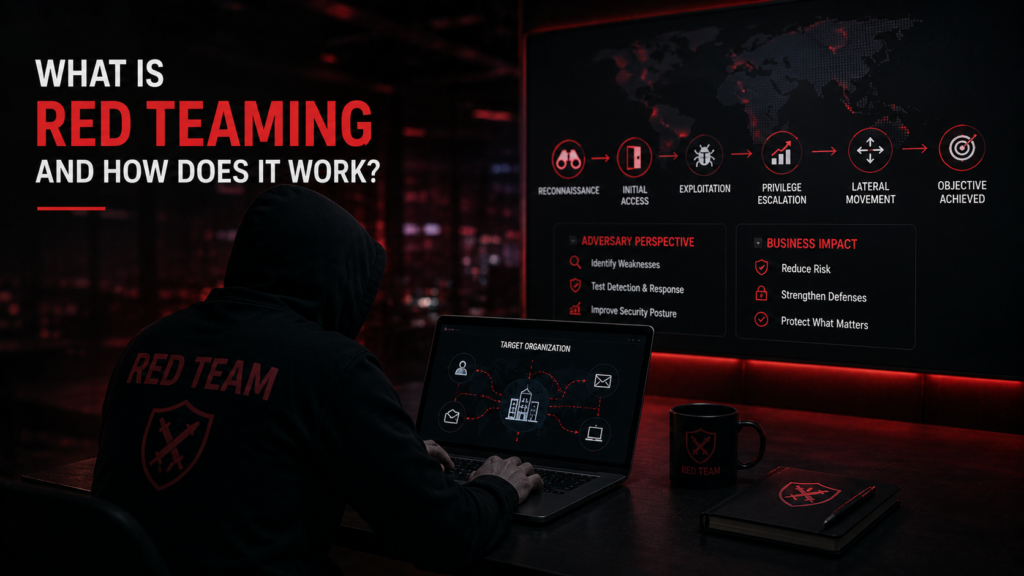
A red team engagement runs through five phases: planning and objective definition, reconnaissance and attack surface mapping, initial access, post-exploitation and objective pursuit, and reporting with a full attack narrative. Each phase is longer and less prescriptive than the equivalent stage in a penetration test, because the red team adapts its approach based on what each phase reveals rather than following a fixed methodology.
Phase 1: Planning and objective definition. The engagement begins with a detailed rules of engagement document that defines the objective, the time horizon, permitted and excluded techniques, emergency contact procedures if the engagement causes unintended disruption, and whether any systems are completely out of bounds. A clear objective is the most important element: “exfiltrate data from the HR system” is a testable objective. “Test our security” is not. This phase also includes threat intelligence work to identify which threat actor profiles are most relevant to the organization’s industry and geography, so the red team’s tactics reflect realistic adversary behavior.
Phase 2: Reconnaissance and attack surface mapping. The red team gathers intelligence about the organization using open sources, passive reconnaissance techniques, and active probing where the rules of engagement permit. This maps the organization’s external attack surface, identifies technology stacks, discovers personnel through public sources for social engineering targeting, and builds a picture of the attack paths most likely to lead to the objective. The attack surface is rarely limited to what the organization knows is exposed. Our post on what attack surface management is explains why unknown exposure is consistently the most exploited category in adversary simulations.
Phase 3: Initial access. The red team attempts to gain a foothold in the organization’s environment through whichever initial access technique the reconnaissance identified as most likely to succeed. This might include a targeted spear-phishing campaign against specific employees identified during reconnaissance, exploiting a vulnerability in an internet-facing system, social engineering the help desk, or gaining physical access to a facility if in scope. The initial access phase is where the blue team’s detection capabilities first have a meaningful opportunity to fire.
Phase 4: Post-exploitation and objective pursuit. With a foothold established, the red team works toward the defined objective. This involves lateral movement to reach higher-value systems, privilege escalation to gain the access level needed to achieve the objective, persistence mechanisms to maintain access if the initial foothold is discovered and removed, and ultimately the actions on objective such as data exfiltration, account compromise, or system access that the engagement was designed to demonstrate. Throughout this phase, the red team operates as quietly as possible, documenting every action with timestamps and evidence while avoiding unnecessary noise that would make detection more likely than it would be for a real attacker.
Phase 5: Reporting and debrief. The engagement concludes with a full attack narrative documenting every step from initial reconnaissance through to objective achievement, the detection opportunities that existed but were not taken, the security controls that were bypassed and how, and specific recommendations for improving detection, response, and the technical controls that were successfully circumvented. Unlike a penetration test report, the red team report is organized around the attack story rather than a findings list. The debrief session with the security team, and sometimes the blue team, is where the most valuable learning happens.
What Is the Difference Between Red Team, Blue Team, and Purple Team?
Red team, blue team, and purple team refer to the three roles in an adversarial security exercise. The red team attacks. The blue team defends without knowing the attack is happening. Purple team exercises bring both teams together in a collaborative format, where the red team shares tactics with the blue team in real time so they can tune detection and response during the exercise rather than discovering gaps in the post-engagement report.
The red team consists of offensive security professionals operating as adversaries. Their objective is to achieve the engagement goal using realistic attacker tactics while remaining undetected as long as possible. Red team members need a broad offensive skill set spanning technical exploitation, social engineering, and, in some engagements,s physical security testing, combined with the patience to operate over an extended timeframe without triggering detection.
The blue team is the organization’s existing security operations function, monitoring alerts, investigating suspicious activity, and responding to incidents as usual. In a genuine red team exercise, the blue team is not told the exercise is happening. Their response to the red team’s actions is the primary data the exercise produces, and it is only valid as evidence of real response capability if they operate under realistic conditions rather than in a heightened-awareness, prepared state.
The purple team model modifies this structure by having red and blue team members work together, with the red team executing techniques and the blue team attempting to detect them in real time, iterating through coverage gaps and tuning detection rules during the exercise. Purple teaming improves detection coverage faster but does not test the blue team’s unprimed response capability the way a genuine red team exercise does. Both have value depending on the organization’s maturity and specific objectives.
Who Actually Needs Red Team Testing?
Red team testing is appropriate for organizations with a mature security program that have addressed foundational vulnerabilities, have a functioning security operations capability with detection and response tooling in place, and want to know whether those investments work against a sustained, realistic adversary. It is not the right starting point for organizations that have not yet conducted basic security testing.
The readiness indicators that suggest an organization is ready for red team testing:
Foundational security testing is already in place. Regular penetration testing and vulnerability assessments run on schedule, findings are remediated, and the security program is not actively managing a large backlog of known critical vulnerabilities. Running a red team exercise against an environment with significant unaddressed vulnerabilities produces results that could have been predicted from the penetration test data, without the additional insight that makes red teaming valuable.
A security operations capability exists. Red teaming tests detection and response. If the organization has no meaningful detection capability to test, the exercise answers a question it already knows. Red teaming adds value when the blue team has invested in detection tooling, playbooks, and alert response processes, and the question is whether those investments work under realistic attack conditions.
Security leadership needs evidence for strategic decisions. Red team results are most valuable for informing investment decisions. If the exercise shows that the endpoint detection tool fires reliably but the network monitoring coverage has significant blind spots, that is a strategic prioritization signal. If social engineering consistently produces initial access faster than any technical path, that signals an investment in security awareness programs.
Organizations that are still building their foundational security program are better served by penetration testing and vulnerability assessment before investing in red team exercises. Our vulnerability assessment and penetration testing services provide the right foundation for organizations earlier in their security program maturity.
For organizations evaluating the full landscape of security testing options, including red teaming, our post on manual vs automated penetration testing covers where human judgment is irreplaceable in security testing, which is directly relevant to understanding why red teaming is a fully manual discipline.
How Does Red Teaming Relate to Attack Surface Management?
Red teaming and attack surface management address the same fundamental risk from different angles. Attack surface management continuously discovers and monitors the assets an attacker could target, providing an ongoing, real-time picture of what is exposed. Red teaming actively tests whether that exposed surface can be exploited to achieve a meaningful objective, providing a point-in-time validation of whether the exposure translates into real risk.
The relationship is complementary rather than competitive. An organization without attack surface management running a red team exercise may have unknown exposed assets that the red team discovers during reconnaissance, meaning the exercise reveals exposure the security team was unaware of rather than testing the security of what they knew about. An organization with mature attack surface management that has never run a red team exercise may have excellent visibility into its exposure but no evidence of whether that exposure can be chained into a meaningful compromise.
Attack surface management creates the intelligence baseline that makes red team exercises more focused and more realistic. The red team can concentrate on the highest-risk areas of the attack surface rather than spending significant engagement time on discovery that a continuous monitoring program should already have covered. Our attack surface management service is designed to work alongside adversarial testing in exactly this way, providing the continuous discovery layer that keeps the attack surface picture current between point-in-time red team exercises.
How Long Does a Red Team Engagement Take?
A red team engagement typically runs four to twelve weeks from kickoff to final report delivery, with the active attack phase running two to eight weeks depending on the engagement scope, objective complexity, and how quickly initial access is achieved. The extended timeline compared to a penetration test is essential, not optional, because real adversaries operate over extended periods rather than within a defined testing window.
The timeline breaks down by engagement phase. Planning and objective definition take one to two weeks. Reconnaissance runs in parallel with planning and continues throughout the initial access phase. The active attack phase, from first compromise attempt through to objective achievement or engagement conclusion, runs two to eight weeks. Report writing and debrief take one to two weeks.
The active phase duration is not fully predictable in advance. A red team that achieves initial access through a phishing campaign in the first week will have more time to pursue the objective and produce richer post-exploitation evidence than one that spends four weeks attempting initial access methods that are effectively blocked. The engagement length should be set long enough that the exercise produces meaningful post-exploitation evidence even if initial access takes longer than expected.
How Does Red Teaming Compare to Bug Bounty Programs?
Red teaming and bug bounty programs both use external security expertise to find vulnerabilities, but they produce different outputs, test different things, and suit different organizational needs. A bug bounty program crowdsources vulnerability discovery from an open or invite-only researcher community and rewards individual findings per vulnerability. Red teaming uses a focused expert team to simulate a specific threat actor pursuing a specific objective.
Bug bounty programs are effective at maintaining broad vulnerability coverage across a large or complex attack surface over an extended period. Researchers with diverse expertise and techniques continuously test the public-facing surface and report findings as they discover them. The breadth and continuity of coverage are the primary advantage.
Red teaming provides something bug bounty programs cannot: a test of whether vulnerabilities can be chained together to achieve a meaningful objective, and whether that chain of attack can be executed without triggering detection. A bug bounty researcher reports an individual vulnerability. A red team demonstrates whether that vulnerability, combined with two others, allows a threat actor to reach the crown jewels undetected over three weeks.
For organizations that want to understand both disciplines in detail, our post on bug bounty program explains how bug bounty programs work and when they provide the best value, which is useful context for positioning it correctly alongside red teaming in a mature security program. Our bug bounty service is structured for organizations that want managed researcher engagement alongside their periodic red team and penetration testing cycles.
Frequently Asked Questions
Does the security team know when a red team exercise is happening?
In a genuine red team engagement, the security operations team does not know. Only a small number of senior stakeholders, typically the CISO and one or two executives, are informed. This is essential because the exercise is testing whether the security team can detect and respond to an attack, not whether they can detect an attack they were told to look for. Some organizations choose a “white team” structure where one trusted internal person acts as a liaison between the red team and senior leadership without informing the operations team.
Can a red team exercise cause real damage to production systems?
A properly scoped red team engagement includes explicit rules of engagement that prevent genuinely destructive actions. The exercise excludes actions that could cause data loss, system outages, or permanent infrastructure changes. The red team simulates these actions without executing them, documenting that the access to take such actions was achieved without actually exercising it. Communication protocols with senior stakeholders allow the exercise to pause or stop immediately if something unexpected occurs.
How is red teaming different from a full penetration test?
A penetration test is scoped, time-limited, finds vulnerabilities across a defined target list, and produces a findings report for the security and engineering team. A red team engagement is objective-based, extended, tests detection and response as well as technical vulnerabilities, and produces an attack narrative for security leadership. Penetration testing suits most organizations. Red teaming adds value specifically for organizations with a mature security program that needs validation rather than vulnerability discovery.
What qualifications should a red team have?
Red team members need demonstrated experience across offensive security disciplines: network exploitation, web application security, Active Directory attacks, social engineering, and in some cases physical security. Relevant certifications include OSCP, CRTO, CRTE, PNPT, and for more senior practitioners, OSED and OSEP. Beyond certifications, genuine red team experience requires judgment built from conducting full-scope adversary simulations rather than just vulnerability-focused assessments, which is why red team expertise is rarer and more expensive than general penetration testing expertise.
What is a TIBER or TLPT red team exercise?
TIBER (Threat Intelligence-Based Ethical Red Teaming) and TLPT (Threat-Led Penetration Testing) are regulated red team frameworks used in the financial services sector in Europe. Required under DORA for entities performing critical functions, they involve coordination between the tested entity, the red team provider, and the relevant financial supervisory authority. The exercise is based on threat intelligence reports about the threat actors most relevant to the specific organization, making it the most realistic and rigorous form of regulated adversary simulation currently in use.
The Test That Tells You Whether Your Security Actually Works
Vulnerability discovery is necessary. Knowing what is broken in your environment is the prerequisite for fixing it, and penetration testing and vulnerability assessment are the tools that answer that question. But knowing what is broken is not the same as knowing whether your security program would actually stop or detect an attacker who found those weaknesses and chained them together into a real attack.
Red teaming is the test that answers the harder question. Not “what vulnerabilities exist” but “could an adversary achieve a meaningful objective in our environment, and if so, would we know?” It tests detection rules, alert-response playbooks, communication protocols under pressure, and the human judgment of the people running the security operations center when something anomalous appears in the logs at 2 am.
Organizations that commission red team exercises consistently discover that some parts of their security program work better than expected and some work worse. Both findings are valuable. The ones that don’t exist yet in their environment are the ones worth finding before a real adversary does.
Contact us to discuss a red team engagement for your organization.