How Much Does Cloud Penetration Testing Cost in 2026?

Written By
Sarwat Iftikhar
Cloud penetration testing costs more than most buyers expect on their first quote request, and less than they fear once they understand why. The price variation between engagements is significant because cloud environments differ fundamentally in size and architecture. What actually needs to be tested, and those differences translate directly into testing time, tester expertise required, and the depth of findings a good engagement produces.
Across Bugstrix cloud security engagements, the range for a focused, mid-market cloud penetration test runs from $8,000 for a single-cloud environment with a defined scope to $50,000 and above for multi-cloud infrastructure with complex IAM configurations, containerized workloads, and serverless components. Enterprise environments with custom integrations, regulated data, and multiple cloud accounts in scope run higher still.
This post breaks down exactly what drives cloud penetration testing costs, what your budget should realistically look like for different environment types, and what separates an engagement worth paying for from one that leaves your actual risk undiscovered.
Key Takeaways
- Cloud penetration testing ranges from $8,000 for a focused single-cloud assessment to $50,000+ for multi-cloud enterprise environments in 2026.
- IAM configuration testing is the most time-intensive component of any cloud penetration test and the single largest driver of cost beyond basic scope size.
- Cloud pen tests cost more than traditional network tests because the attack surface is architectural rather than perimeter-based, requiring specialized knowledge of cloud-provider-specific services and shared responsibility boundaries.
- In Bugstrix cloud assessments, IAM misconfigurations and overly permissive service account access are the two most consistently present critical findings regardless of cloud provider.
- The gap between a cloud security posture scan and a real cloud penetration test is the difference between identifying theoretical misconfigurations and confirming whether those misconfigurations lead to a genuine attack path.
Why Does Cloud Penetration Testing Cost More Than Traditional Testing?
Cloud penetration testing costs more than traditional network testing because the attack surface is fundamentally different and requires a different methodology. A traditional network test probes a relatively predictable set of targets: IP addresses, ports, services, and authentication systems. Cloud testing examines architecturally more complex aspects: identity and access management policies, service trust relationships, storage permissions, API gateway configurations, serverless execution contexts, and the boundaries between what the cloud provider secures and what the customer must secure themselves.
That complexity requires testers with cloud-provider-specific expertise, not just general penetration testing skills. Testing an AWS environment correctly requires understanding IAM permission boundaries, cross-account trust relationships, service control policies, and how specific AWS services interact to create exploitable paths. The same is true for Azure and Google Cloud, each with their own architecture, permission models, and service-specific security controls. A tester who is skilled at web application penetration testing but unfamiliar with cloud-native attack paths will miss the findings that matter most in a cloud environment.
The shared responsibility model also introduces complexity not present in on-premises testing. Cloud providers secure the underlying infrastructure. Customers are responsible for securing everything they deploy on top of it, including IAM configurations, storage access controls, network security groups, data encryption, and logging. A cloud penetration test must clearly understand where the provider’s responsibility ends and the customer’s begins, and then thoroughly test the customer’s portion, which requires a clear scoping conversation before testing begins.
How Much Does Cloud Penetration Testing Actually Cost in 2026?
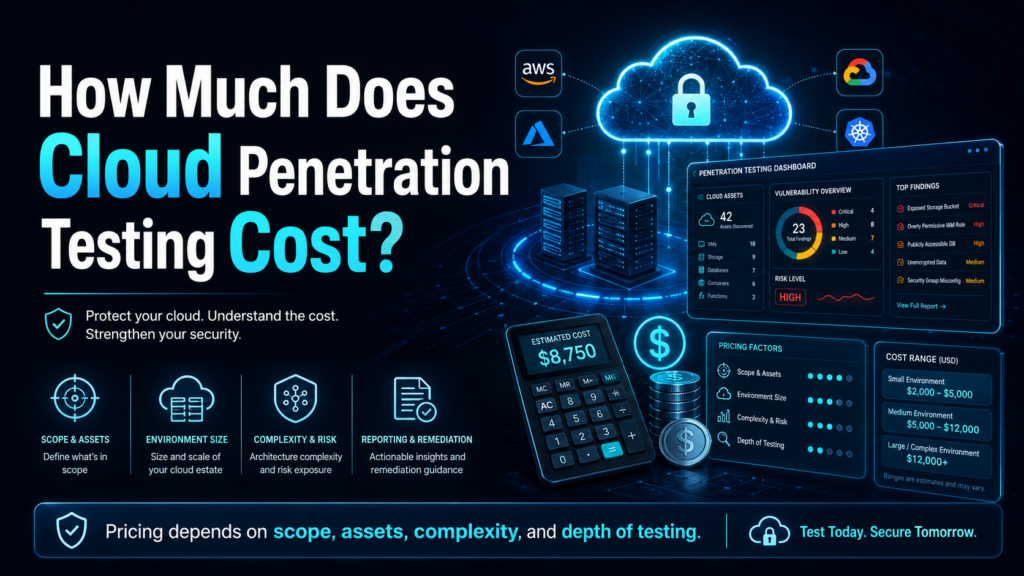
Cloud penetration testing costs between $8,000 and $50,000 for most mid-market engagements in 2026, with the specific price driven primarily by the number of cloud accounts in scope, the architectural complexity of the environment, and the depth of IAM and service configuration testing required. Simple, well-bounded single-cloud environments sit at the lower end. Multi-cloud environments with Kubernetes, serverless functions, and complex identity federation sit significantly higher.
| Environment Type | Cost Range | What’s Covered |
| Single Cloud, Limited Scope | $8,000 – $15,000 | Basic IAM + storage review |
| Single Cloud, Full Scope | $15,000 – $25,000 | Deep IAM, APIs, containers |
| Multi-Cloud Environment | $25,000 – $50,000 | Cross-cloud trust + identity |
| Enterprise + Kubernetes | $50,000 – $100,000+ | Regulated data, custom infra |
| Serverless + Microservices | $20,000 – $45,000 | Function + event-driven scope |
Source: Bugstrix cloud engagement pricing data + industry benchmarks, 2026
Cloud penetration testing costs scale with architectural complexity rather than simply with the number of IP addresses or hosts, which distinguishes it from traditional network testing pricing.
Here is what the major cloud environment types realistically cost at market rates in 2026:
A single-cloud, limited-scope assessment covering IAM configuration review, storage permission analysis, and network exposure testing for a well-bounded AWS, Azure, or Google Cloud environment runs $8,000 to $15,000. This is appropriate for a startup with a straightforward cloud footprint wanting a first-time assessment before a compliance audit.
A single-cloud, full-scope assessment that includes deep IAM privilege escalation testing, API gateway security, container and serverless function security, logging and monitoring validation, and network segmentation testing runs $15,000 to $25,000. This is the engagement most mid-market companies pursuing SOC 2 or ISO 27001 compliance need.
A multi-cloud environment assessment covering cross-cloud trust relationships, federated identity configurations, and attack paths spanning multiple providers costs $25,000 to $50,000. This reflects the additional tester time required to understand and test interactions between environments, where the most significant vulnerabilities in multi-cloud architectures tend to reside.
Enterprise environments with Kubernetes clusters, regulated data requirements, custom networking, and multiple cloud accounts cost $50,000 or more. These engagements require extended testing timelines and reporting formats that satisfy both internal security teams and auditors.
For a broader view of how cloud penetration testing fits alongside other types of assessment and what drives pricing across the full range of engagement types, our post on how much a penetration test costs in 2026 covers the complete pricing landscape.
What Factors Drive Pricing for Cloud Penetration Testing?
Cloud penetration testing pricing is driven by IAM complexity, environment scope, the number of cloud accounts and regions in play, whether serverless or containerized workloads are in scope, and the depth of reporting required. These factors scale independently, which means a small single-account environment with highly complex IAM can cost more than a large multi-account environment with straightforward permissions.
IAM configuration depth is the dominant cost driver in cloud testing and the factor buyers most consistently underestimate. Cloud IAM testing is not simply confirming that users have appropriate roles. It involves mapping every permission boundary, testing for privilege-escalation paths via chained permissions, validating that cross-account role assumptions are properly restricted, and confirming that service accounts and instance profiles do not retain excessive permissions that an attacker could leverage after an initial compromise. This work is time-intensive and requires significant cloud-provider-specific expertise to do correctly.
Number of cloud accounts and regions matters because each account is effectively a separate testing environment with its own configuration, permission model, and potential cross-account trust relationships. An organization running 10 AWS accounts with cross-account roles presents a fundamentally different testing scope than one running a single account, even if the underlying services deployed look similar.
Containerized and serverless workloads add distinct testing requirements that extend beyond standard cloud infrastructure testing. Kubernetes environments require testing container escape scenarios, RBAC misconfigurations, secrets management practices, and pod security policies. Serverless functions require testing event trigger manipulation, function permission boundaries, and environment variable exposure. Both add meaningful time to the engagement.
Compliance requirements add 15-30% to baseline cloud testing costs when the engagement must produce evidence for PCI DSS, SOC 2, ISO 27001, or DORA. Compliance-driven cloud tests require specific evidence formats, criteria mapping in the report, and retest documentation that satisfy auditors, not just security teams.
What Is the Difference Between a Cloud Security Posture Assessment and a Cloud Penetration Test?
A cloud security posture assessment identifies misconfigurations by comparing your environment against security best practices. A cloud penetration test goes further, actively exploiting confirmed vulnerabilities to demonstrate whether they lead to genuine attack paths, privilege escalation, or data access. Both are useful, but only the penetration test produces evidence of actual exploitability rather than theoretical risk.
Cloud security posture management tools automatically flag configuration issues. They are good at identifying publicly accessible storage buckets, overly permissive security groups, disabled logging, and missing encryption. They are not good at determining whether any of those findings lead to meaningful impact in your specific environment, or whether an attacker could chain multiple lower-severity findings into a significant breach path.
In Bugstrix cloud assessments, the most valuable findings are rarely surfaced by posture scanning tools. They come from a tester who identifies that a developer service account has a combination of permissions that, when combined across three different services, allows full administrative access to production systems. A scanner evaluates each permission individually and may not flag any as critical. A human tester maps the chain and demonstrates the impact.
That distinction matters for cost as well. A posture assessment is faster and therefore cheaper. A penetration test requires more tester time, more cloud-specific expertise, and more work to produce exploitation evidence rather than a configuration checklist. The two are not substitutes; organizations that use posture scanning in place of penetration testing are consistently underinformed about their actual exposure.
Does the Cloud Provider Affect Penetration Testing Cost?
The cloud provider primarily affects penetration testing costs through the complexity of its permission model and the breadth of services to be tested, rather than through direct price differences between providers. Testing AWS, Azure, and Google Cloud each requires provider-specific expertise and a methodology tailored to how each platform handles identity, networking, and service configuration.
A single-cloud AWS assessment typically costs slightly more than an equivalent Azure or Google Cloud engagement because AWS environments tend to have more services in scope, more complex IAM configurations, and more extensive permission boundaries to map and test. This is not a universal rule, but it reflects the reality that AWS’s breadth of services and IAM granularity create a larger testing surface for organizations of equivalent size.
Cloud provider rules also affect what can and cannot be tested. All three major providers require customers to notify them before conducting penetration testing and prohibit testing provider-managed infrastructure. The shared responsibility boundary determines what is in scope. A good cloud penetration testing provider understands these boundaries, works within them, and scopes the engagement to cover everything on the customer’s side of that line without committing policy violations that could jeopardize the organization’s relationship with its cloud platform.
Our cloud penetration testing services cover AWS, Azure, and Google Cloud environments with provider-specific methodology and reporting tailored to each platform’s architecture.
What Does a Cloud Penetration Test Report Need to Include?
A cloud penetration test report needs to include a scope definition that maps to your cloud accounts and services; findings documented with evidence of exploitation and realistic business impact; IAM-specific findings with clear remediation guidance mapped to provider-specific controls; and retest results confirming that remediation was effective. A report missing exploitation evidence or business impact context is a posture assessment dressed as a penetration test.
The specific components that distinguish a quality cloud penetration test report:
IAM findings with privilege escalation chains. Each IAM-related finding should document the full chain of permissions that creates the risk, not just the individual permission that looks excessive in isolation. A single over-permissioned role is a configuration note. A chain showing that role leads to full production database access is a critical finding with clear remediation priority.
Exploitation evidence for every critical and high finding. Screenshots, API call logs, and proof-of-concept outputs demonstrating that each finding was confirmed to be genuinely exploitable rather than merely theoretically possible. Without this, the severity of the finding is an opinion rather than a demonstrated fact.
Provider-specific remediation guidance. Remediation guidance that says “reduce IAM permissions” is not useful. Guidance that says “remove the specific permission policy and replace with a scoped policy using these exact condition keys” is. Cloud remediation requires provider-specific knowledge to implement correctly, and a good report delivers that specificity.
Segmentation and network isolation validation. Confirmation that your VPC, security groups, and network ACL configurations actually enforce the isolation your architecture assumes. Findings in this area often have immediate remediation paths and significant impact if exploited.
How Can You Get Maximum Value from Your Cloud Penetration Testing Budget?
Getting maximum value from a cloud penetration testing budget requires scoping the engagement correctly before signing, ensuring the testing methodology covers IAM as a primary target rather than just network exposure, and building in enough lead time before any compliance deadline for remediation and retesting. The biggest waste in cloud testing budgets consistently comes from underscoped engagements that miss the findings that matter, not from paying too much for a thorough test.
The specific practices that maximize value in our Bugstrix cloud engagements:
Define the scope around what an attacker would actually target, not just what feels comfortable to expose to a tester. The cloud environments that generate the most valuable findings in our assessments are those where the client includes their most sensitive workloads and their most complex IAM configurations, not just a staging environment or a subset of accounts. The findings that matter most consistently come from the areas organizations are least comfortable putting in scope.
Request IAM-focused testing as an explicit scope requirement. Generic cloud penetration testing can look like external reconnaissance and basic service enumeration. Ensure the methodology explicitly includes IAM privilege escalation testing, cross-account trust validation, service account permission analysis, and instance profile testing as named deliverables rather than optional components.
Coordinate compliance requirements upfront. If the engagement needs to produce evidence for SOC 2, PCI DSS, or ISO 27001, this needs to be specified before testing begins, not after the report is delivered. Compliance-ready reports require specific evidence formats and criteria mapping that need to be built into the methodology from the start.
Schedule with enough lead time to remediate critical findings. A cloud penetration test that finds critical IAM issues two weeks before an audit has failed at its primary purpose. Bugstrix recommends scheduling cloud penetration tests at least eight weeks before any compliance deadline to allow time for finding review, remediation, and a documented retest.
Get a free quote for your cloud penetration testing engagement
Frequently Asked Questions
How long does a cloud penetration test take?
A focused single-cloud assessment takes one to two weeks for the testing phase. A full-scope single-cloud engagement with deep IAM testing runs two to three weeks. Multi-cloud or enterprise assessments with Kubernetes and serverless components typically run three to five weeks for the testing phase. Add one to two weeks for report preparation and delivery, plus time for remediation and retesting before any compliance deadline.
Is cloud penetration testing the same as a cloud vulnerability scan?
No. A vulnerability scan uses automated tools to flag known misconfigurations and security issues against a baseline. A cloud penetration test has a human tester actively exploiting confirmed vulnerabilities, chaining findings across services, and demonstrating actual attack paths rather than theoretical ones. Scanners identify issues. Penetration testers confirm whether those issues lead to genuine impact in your specific environment.
Does cloud penetration testing require cloud provider approval?
Yes. All three major cloud providers require customers to notify them before conducting penetration testing and prohibit testing provider-managed infrastructure. The specific pre-authorization requirements vary by provider. Your penetration testing firm should handle this notification process as part of the engagement setup, and any provider that begins cloud testing without proper authorization creates a risk to your account standing.
How often should a cloud environment be penetration tested?
Most compliance frameworks require annual testing at minimum. Given how frequently cloud environments change, major infrastructure changes such as new service deployments, cloud migrations, IAM policy overhauls, or new cloud account additions should each trigger a targeted assessment rather than waiting for the next annual cycle. Cloud environments that change frequently benefit from more frequent scoped testing rather than relying entirely on annual full-scope engagements.
What is the difference between a cloud penetration test and a red team exercise?
A cloud penetration test systematically identifies and validates vulnerabilities across your cloud environment. A red team exercise simulates a specific threat actor pursuing a specific objective, testing your detection and response capabilities rather than just your attack surface. Red team engagements are appropriate for organizations with mature cloud security programs that want to test whether their monitoring and response capabilities would actually detect and contain a realistic attack.
What You Should Actually Pay
The organizations that get real value from cloud penetration testing are the ones that scope it correctly, include their most sensitive environments rather than testing a comfortable subset, and use the findings to drive actual remediation rather than produce a compliance report.
Cloud penetration testing is not cheap relative to traditional network testing, and the price difference reflects genuine differences in required expertise and testing depth. An engagement that finds only surface-level misconfigurations that your posture scanning tools would have caught anyway has not delivered value proportional to what cloud testing costs. An engagement that maps the IAM escalation paths, identifies cross-account trust issues, and demonstrates the impact of your most significant misconfiguration has delivered findings worth many times the cost of testing.
Bugstrix cloud engagements are scoped and priced to reflect the actual depth of testing rather than a fixed package rate. The right price for your environment depends on what is actually in scope.