Multi-Tenant SaaS Security Testing: How to Prevent Cross-Tenant Data Leaks

Written By
Sarwat Iftikhar
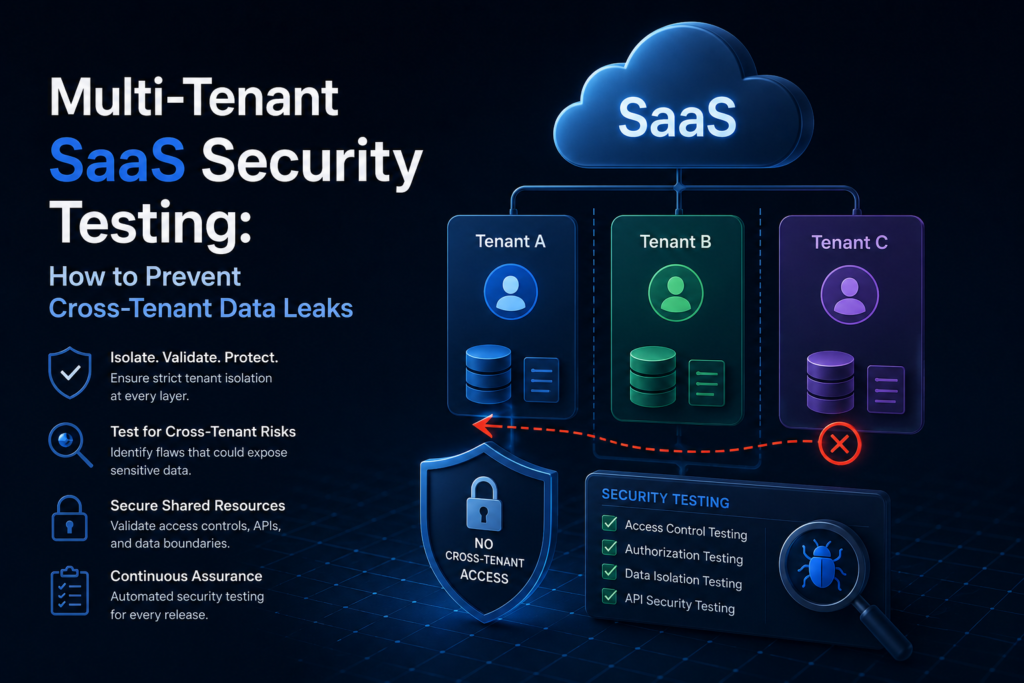
Most SaaS vulnerabilities affect one account. A cross-tenant data leak affects every account simultaneously.
That asymmetry is what makes multi-tenant isolation failures the most consequential vulnerability class in SaaS security. A single missing tenant filter in one database query, one background job running without a tenant context, one cache key that does not include a tenant identifier, and a customer at any subscription tier can read, modify, or export data belonging to every other customer on the platform.
Broken access control has held the number one position in the OWASP Top 10 for the 2025 edition, and Broken Object Level Authorization, the API-specific framing of tenant isolation failure, has held the top spot in the OWASP API Security Top 10 since the list launched. This is not a new problem. It is a persistent one, and across Bugstrix web application assessments, cross-tenant authorization failures appear in the majority of multi-tenant SaaS applications we test for the first time.
This post covers where cross-tenant leaks actually come from, how to test for every meaningful variant, why automated scanning consistently misses the findings that matter most, and how to fix the vulnerabilities that manual testing surfaces.
Key Takeaways
- Cross-tenant data leaks are the most damaging SaaS vulnerability class because a single authorization failure can expose every tenant’s data simultaneously, not just one account.
- IDOR and Broken Object Level Authorization hold the top positions in both the OWASP Top 10 (2025) and OWASP API Security Top 10, reflecting how consistently these vulnerabilities appear in real-world SaaS assessments.
- In SaaS penetration testing data, 755 vulnerabilities were found across 119 assessments in 2025, with access control and business logic issues representing the highest-impact finding categories.
- In Bugstrix multi-tenant assessments, authorization enforced in the UI but missing from the underlying API is the single most consistent cross-tenant finding.
- Automated scanners cannot find cross-tenant vulnerabilities because they require authenticated access to multiple tenant accounts and context-specific understanding of what data each tenant should and should not be able to access.
Why Is Cross-Tenant Data Leakage the Most Critical Risk in Multi-Tenant SaaS?
Cross-tenant data leakage is the most critical risk in multi-tenant SaaS because a single vulnerability in a shared codebase affects every customer simultaneously. In a single-tenant application, an authorization failure exposes one account. In a multi-tenant application running a shared database and shared application layer, the same failure can expose every tenant’s data to any authenticated user who knows how to find it.
This blast radius is what distinguishes multi-tenant isolation failures from most other vulnerability classes. A reflected XSS in a tenant-specific feature is a serious finding. A missing tenant filter in the API endpoint that serves billing records is a catastrophic one, because every customer’s billing history is now accessible to any user across any tenant who can find and hit that endpoint.
The commercial consequences compound the technical ones. A cross-tenant data leak is almost always a multi-party breach. Every affected tenant has a notification obligation, a potential regulatory exposure under GDPR, HIPAA, or relevant data protection law, and a customer relationship to manage. For SaaS companies operating under SOC 2 or ISO 27001, a cross-tenant incident is also a direct audit failure. The contractual obligations to maintain tenant isolation are built into every customer agreement, and when isolation fails, all of those obligations fail simultaneously.
The operational reality is that most cross-tenant leaks exist silently for extended periods before anyone finds them. In one documented case, a developer discovered a tenant isolation bug that had existed from the first week of the platform’s existence, across four months of operation and twelve beta tenant accounts. The bug was never triggered maliciously because no one looked for it. Security testing is what looks for it.
Where Do Cross-Tenant Data Leaks Actually Come From?
Cross-tenant data leaks come from a specific and recurring set of architectural failure patterns, most of which involve some shared resource, whether a database, cache, background job, or storage bucket, that was not properly scoped to a single tenant’s context. The failures are rarely dramatic. They are almost always a missing WHERE clause, a missing cache key prefix, or a background job that loads data without the tenant context that API calls carry automatically.
IDOR across API endpoints is the most common finding in multi-tenant SaaS testing. It occurs when an API endpoint takes an object ID as a parameter and returns the corresponding data without checking whether the authenticated user’s tenant owns that object. Sequential integer IDs make this trivially exploitable. Tenant A’s user with object ID 1247 changes the parameter to 1248 and reads Tenant B’s record. UUIDs reduce the ease of enumeration but do not prevent the underlying authorization failure.
Authorization enforced in the UI but missing from the API is the finding that consistently surprises engineering teams the most. A feature that correctly checks permissions when accessed through the web interface may have the authorization logic in the frontend JavaScript or in a middleware layer that does not apply when the underlying API endpoint is called directly. Any user who examines the network traffic, finds the raw API endpoint, and calls it without going through the UI can bypass the authorization check entirely.
Missing tenant filter in database queries produces the widest blast radius of any cross-tenant failure. A query that returns all records matching a condition without also filtering on tenant ID exposes every tenant’s matching data to whoever triggers the query. A search endpoint that returns all accounts matching a search term, rather than all accounts belonging to the requesting tenant that match the term, is one of the most common variants we encounter in Bugstrix assessments.
Cache key contamination happens when data is cached using a key that identifies the resource but not the tenant. If the cache key for a user’s dashboard is based on their user ID without a tenant prefix, the first tenant’s dashboard data that gets cached serves to anyone else whose request maps to the same cache key. This is particularly common in applications that were built as single-tenant systems and later converted to multi-tenant architectures without a full audit of cache key structures.
Background job context loss is one of the hardest failure modes to catch through manual testing. Asynchronous jobs scheduled by one tenant’s request sometimes execute outside the request context that carries the tenant identifier. If the job code does not explicitly pass and enforce the tenant context, the job runs without isolation constraints and can operate on data across tenant boundaries.
How Do You Test a Multi-Tenant SaaS Application for Cross-Tenant Vulnerabilities?
Testing a multi-tenant SaaS application for cross-tenant vulnerabilities requires two or more fully provisioned tenant accounts, manual testing of every endpoint and function that accesses tenant-scoped data, and systematic attempts to access Tenant A’s data while authenticated as Tenant B. Automated scanners cannot perform this testing because they require the tester to understand what data belongs to each tenant and to attempt to cross those boundaries actively.
The multi-tenant testing methodology that Bugstrix applies across SaaS engagements works as follows:
Provision two or more test tenants with distinct data. Before any testing begins, each test tenant account needs a representative dataset of objects that can be referenced by ID during testing. Invoices, projects, users, reports, files, and any other tenant-scoped resource type should have distinct records in each tenant so the tester can definitively determine whether cross-tenant access succeeded.
Enumerate every endpoint and parameter that accepts an object identifier. This includes URL path parameters, query string parameters, request body fields, GraphQL arguments, and any other mechanism by which the application accepts a reference to a tenant-scoped resource. This enumeration needs to cover authenticated API endpoints directly, not just the features visible in the UI, because the most commonly missed cross-tenant vulnerabilities live in API endpoints that the UI does not surface obviously.
Systematically attempt cross-tenant access for every identified endpoint. Authenticated as Tenant B’s user, attempt to access every object identifier associated with Tenant A using every identified endpoint. This includes read operations, write operations, delete operations, and any function that operates on tenant-scoped objects. The test for each endpoint is deterministic: either the application returns Tenant A’s data, or it returns a 403, 404, or equivalent rejection.
Test functions that the UI cannot trigger directly. Export functions, reporting endpoints, invitation flows, admin APIs, integration endpoints, and background job triggers all need to be tested for cross-tenant isolation. These are frequently missed by testing that only follows the visible application flow.
Test asynchronous and background processes. Background jobs, scheduled tasks, and webhook handlers that process tenant data need to be verified for tenant context enforcement. This sometimes requires examining application code rather than just testing the API surface.
Our web app penetration testing services follow this methodology specifically for multi-tenant SaaS applications, covering both the API surface and the authorization logic that makes cross-tenant access possible.
What Is the Difference Between IDOR and Broken Tenant Isolation?
IDOR and broken tenant isolation are related but not identical. IDOR is a specific mechanism that accesses data by manipulating an object identifier without an ownership check. Broken tenant isolation is a broader failure category that includes IDOR but also covers cache contamination, background job context loss, shared storage misconfigurations, and any other mechanism by which one tenant’s data becomes accessible to another, not just by directly manipulating identifiers.
Understanding the distinction matters for testing completeness. An engagement that only tests for IDOR by manipulating URL parameters misses the cross-tenant vulnerabilities that live in caches, queues, background processes, and storage paths. A complete cross-tenant assessment covers all of these vectors, not just the most obvious one.
What connects them is the underlying cause: a shared resource, whether a database, cache, queue, or storage system, that was not properly scoped to a tenant boundary. IDOR exploits the failure at the API layer. Cache contamination exploits the same underlying failure at the caching layer. Background job context loss exploits it at the job execution layer. Each is a different expression of the same fundamental problem: the application does not consistently enforce that every data access path returns only the requesting tenant’s data.
The severity profile differs as well. An IDOR that allows reading another tenant’s records is a critical finding. A cache contamination issue that serves one tenant’s dashboard data to another is also critical but requires different testing techniques to identify. Row-Level Security bypass vulnerabilities, as documented in recent PostgreSQL advisories covering optimizer statistics leaking data from RLS-protected rows, represent a category of cross-tenant exposure that sits below the application layer entirely, requiring database-level testing and sometimes code-level review to surface.
For cross-tenant vulnerabilities that originate in code structure rather than API behavior, our cybersecurity code review services examine the data access patterns, query construction, and context propagation within the application code that produce cross-tenant exposure.
For broader context on how web application penetration testing methodology applies to multi-tenant architectures specifically, our post on web application penetration testing covers the foundational approach.
Why Can’t You Rely on Automated Scanning to Find Cross-Tenant Vulnerabilities?
Automated scanning cannot find cross-tenant vulnerabilities because the tools have no way to distinguish between data that legitimately belongs to the scanning account and data that belongs to another tenant. A scanner that sends a request to an API endpoint and receives a 200 response cannot determine whether the response contains Tenant A’s data or Tenant B’s data. Only a human tester with separate accounts for each tenant and knowledge of what data each account contains can make that determination.
This is the same reason that IDOR has held the top spot in the OWASP API Security Top 10 since the list launched despite being a well-understood vulnerability class. It is not that automated tools have not been built to find it. It is that finding it requires semantic understanding of what data belongs to which context, and that understanding requires a human tester who can set up separate tenant contexts and compare the responses.
The 2025 SaaS penetration testing data makes this concrete. Across 119 SaaS assessments, the highest-impact findings were concentrated in access control, business logic, and tenant isolation, precisely the categories that require context-aware human testing rather than automated tool execution. The findings that automated tools do catch, known CVEs in identified software versions, missing security headers, and basic injection indicators, represent a small fraction of the actual risk in a multi-tenant SaaS environment.
In Bugstrix SaaS assessments, we use automated tooling for reconnaissance, dependency analysis, and initial surface mapping. Every cross-tenant finding comes from manual testing with provisioned tenant accounts specifically configured to make cross-tenant access detectable. That division of labor reflects where automated tools add value and where they structurally cannot produce the findings that matter.
What Does a Proper Multi-Tenant Security Test Actually Look Like?
A proper multi-tenant security test involves provisioned test tenant accounts, systematic manual testing across every API endpoint and function that handles tenant-scoped data, code-level review of data access patterns and cache key construction, and retesting of all identified vulnerabilities after remediation. The test should produce a report that maps every finding to the specific tenant boundary it violates and provides clear remediation guidance at the code level.
The testing engagement structure that produces complete coverage in Bugstrix multi-tenant SaaS assessments:
Pre-engagement: scope definition and tenant provisioning. Before testing begins, the scope is defined to include every application component that handles tenant data: web application, APIs, admin interfaces, integration endpoints, background job interfaces, and export functions. Two or more test tenant accounts are provisioned with realistic but synthetic data that allows cross-tenant access attempts to be confirmed definitively.
API surface enumeration. Every API endpoint is catalogued using a combination of application documentation, network traffic analysis during normal application use, and JavaScript source analysis. The enumeration specifically targets authenticated endpoints, admin endpoints, and internal endpoints that may not be visible through the standard application UI.
Systematic cross-tenant authorization testing. Every endpoint that accepts a tenant-scoped object identifier is tested for cross-tenant access. This includes standard CRUD operations and function-specific endpoints like export, duplicate, share, invite, and search. Both horizontal (same permission level, different tenant) and vertical (different permission level within a tenant) access control failures are tested.
Background process and cache analysis. Application code related to caching strategy, background job scheduling, and async task execution is reviewed to identify tenant context propagation gaps. This review cannot always be completed purely through external testing and may require source code access for complete coverage.
Remediation and retest. Every identified vulnerability is remediated according to the guidance provided in the report, and a retest confirms that the remediation closes the vulnerability without introducing new paths to the same outcome.
Our penetration testing services include multi-tenant isolation testing as a core component of every SaaS web application engagement, with the provisioned-tenant methodology described above built into the scope definition process.
Get a free quote for a multi-tenant SaaS security assessment.
How Should Developers Fix Cross-Tenant Vulnerabilities?
Developers should fix cross-tenant vulnerabilities by enforcing tenant scoping at the data access layer rather than the UI or middleware layer, ensuring every database query includes an explicit tenant filter, and building tenant context propagation into the request handling infrastructure so it cannot be forgotten in individual code paths.
The fixes that reliably close cross-tenant vulnerabilities share a common principle: move tenant enforcement as close to the data as possible and make it impossible to omit by accident.
Enforce tenant filtering in the data access layer, not the API layer. An API handler that receives a request, extracts the tenant ID from the authenticated session, and passes it to a data access function still fails if a developer later writes a new data access function that forgets to use the tenant ID parameter. Repository patterns, object-relational mapping scopes, and database middleware that automatically apply tenant filters to every query make tenant enforcement an opt-out rather than an opt-in. PostgreSQL Row-Level Security, when implemented correctly, provides a database-level enforcement layer that the application cannot bypass by accident.
Validate object ownership explicitly on every data operation. For every API endpoint that accepts an object identifier, the handler should confirm that the object belongs to the requesting tenant before performing any operation on it. This check should happen at the data access layer regardless of any higher-level authorization that has already been applied.
Include tenant identifiers in every cache key. Any cached data that is tenant-specific needs a cache key that includes the tenant identifier, not just the resource identifier. A cache key like invoice:{id} without a tenant prefix will serve one tenant’s data to another if their requests map to the same resource ID.
Propagate tenant context through async execution. Background jobs, scheduled tasks, and message queue consumers need to receive and enforce the tenant context of the originating request explicitly. Relying on session context or thread-local storage that does not survive the async boundary is a source of consistent cross-tenant failures in asynchronous architectures.
How Often Should a Multi-Tenant SaaS Application Be Tested?
A multi-tenant SaaS application should be tested for cross-tenant vulnerabilities at minimum annually, and additionally after any feature release that modifies tenant data access patterns, authorization logic, or the APIs that serve tenant-scoped data. Annual testing catches the vulnerabilities that accumulate between feature development cycles. Release-triggered testing catches vulnerabilities introduced by specific feature changes.
The argument for annual minimum testing is straightforward. SaaS applications change continuously. Each new feature that handles tenant data is a new opportunity to introduce a cross-tenant vulnerability. A penetration test from twelve months ago does not tell you whether the features shipped in the last quarter are correctly enforcing tenant isolation.
The argument for release-triggered supplemental testing is equally clear. When a team ships a new export feature, a new reporting endpoint, or a new integration that accesses tenant data, that specific feature needs to be tested before it reaches customers at scale. Waiting until the next annual assessment to test a feature that has been in production for eight months is not an acceptable approach for a platform that has contractual obligations to maintain tenant isolation.
For SaaS companies navigating the question of testing frequency in more detail, including how compliance requirements affect the testing calendar, our post on how often a SaaS company should run a penetration test covers the full decision framework.
Frequently Asked Questions
What is a cross-tenant data leak in SaaS?
A cross-tenant data leak occurs when a user belonging to one tenant in a multi-tenant SaaS application can access, read, modify, or export data belonging to another tenant. This typically happens through IDOR vulnerabilities in API endpoints, missing tenant filters in database queries, or shared resources like caches and storage buckets that are not properly scoped to individual tenant boundaries. Because SaaS applications share a common codebase across all tenants, a single vulnerability can expose every customer’s data.
Can automated scanners find cross-tenant vulnerabilities?
No. Automated scanners have no way to determine whether data returned by an API endpoint belongs to the requesting tenant or to a different one. Finding cross-tenant vulnerabilities requires a human tester with separate provisioned accounts for at least two different tenants, who can actively attempt to access data from one account while authenticated as another and confirm whether the attempt succeeds. This is the primary reason IDOR and Broken Object Level Authorization consistently appear at the top of OWASP’s vulnerability rankings despite being well-documented.
What is the difference between IDOR and tenant isolation failure?
IDOR is a specific mechanism where an application returns data belonging to one account when a different account manipulates an object identifier in a request. Tenant isolation failure is the broader category that includes IDOR but also covers cache contamination, background job context loss, shared storage path misconfigurations, Row-Level Security bypass, and any other mechanism by which tenant boundaries fail. Every IDOR in a multi-tenant application is a tenant isolation failure, but not every tenant isolation failure is an IDOR.
How do you prevent cross-tenant data leaks in a multi-tenant SaaS application?
The most reliable prevention strategy is enforcing tenant filtering at the data access layer rather than the API or middleware layer, so it is structurally impossible for an individual code path to omit the tenant check. This means using repository patterns or ORM scopes that automatically apply tenant filters, database-level row security that enforces tenant scoping below the application layer, and explicit ownership validation for every API operation that accepts an object identifier. Cache keys for tenant-scoped data must include the tenant identifier, and background jobs must receive and enforce tenant context explicitly.
How long does a multi-tenant SaaS security test take?
A focused multi-tenant security test covering cross-tenant authorization testing across the application’s API surface typically takes one to two weeks for the testing phase, depending on the number of endpoints and the complexity of the tenant data model. Engagements that include code-level review of data access patterns and background job handling run longer. Full-scope SaaS assessments that combine cross-tenant testing with broader web application and API testing typically run two to three weeks.
Tenant Isolation Is Not a One-Time Problem
The most consistent pattern in Bugstrix multi-tenant SaaS assessments is that cross-tenant vulnerabilities do not appear once and get fixed. They reappear with every feature that handles tenant data, because the conditions that produce them a shared data layer and a codebase that must explicitly enforce tenant boundaries on every data access path, are permanent features of the architecture.
That is not an argument against fixing them. It is an argument for treating tenant isolation as a continuous engineering discipline rather than a security audit checkbox. The enforcement patterns that make tenant isolation reliable data access layers that cannot omit the tenant filter, cache key structures that include the tenant identifier, and async execution that carries tenant context are engineering decisions that need to be made once and applied everywhere, not retrofitted after a penetration test finds gaps.
Testing makes gaps visible before customers find them. It needs to happen on a cadence that reflects how quickly the application changes, not how often an audit requires it.
Contact us to discuss your SaaS application’s tenant isolation testing requirements.