AI Cybersecurity Risks for Businesses Using Chatbots and AI Agents in 2026

Written By
Sarwat Iftikhar
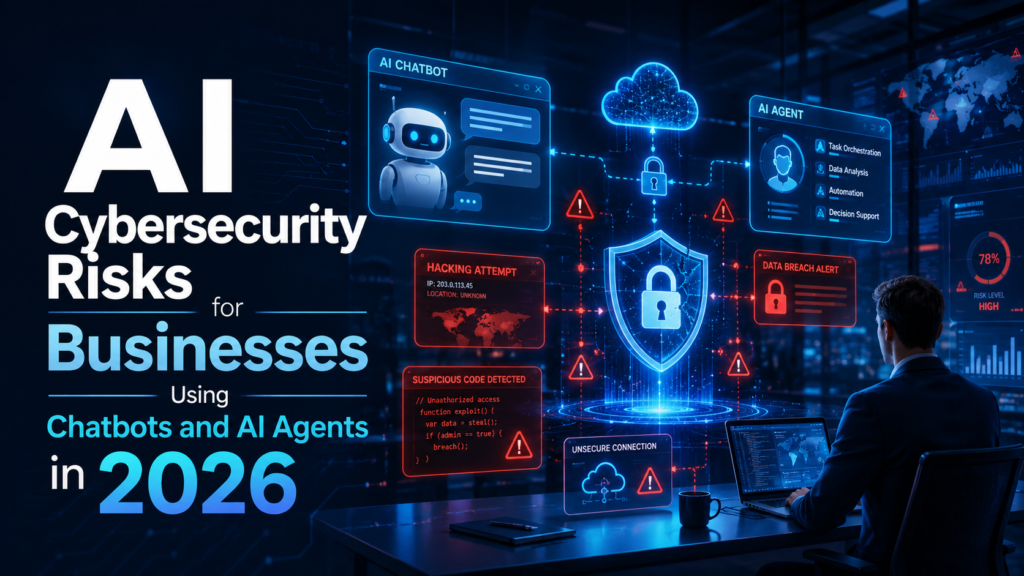
Most businesses deploying chatbots and AI agents in 2026 are focused on what these systems can do: answer customer questions, automate workflows, process documents, and handle tasks that used to require a human. Very few are focused on what these systems can be made to do by someone who wasn’t supposed to use them at all.
That gap is where the risk lives. Prompt injection ranks as the number one vulnerability in the OWASP Top 10 for LLM Applications for the second consecutive year. Ninety-four percent of AI agents tested in a 2025 benchmark were found vulnerable to being hijacked through the content they were asked to read, not through a software exploit or a data breach, but through ordinary inputs. Over 300,000 AI platform credentials appeared on dark web marketplaces in 2025 alone.
This isn’t theoretical anymore. AI security graduated from a research concern to production use in 2025, and the attack surface is expanding in 2026 as more businesses integrate AI agents with real access to systems. Here’s what the actual risks are, what we see in security assessments, and what businesses deploying these tools need to do about it.
Key Takeaways
- Prompt injection is the number-one AI application vulnerability (OWASP, 2025), with attack success rates ranging from 50% to 84% depending on model configuration.
- 94.4% of AI agents tested in a 2025 benchmark were vulnerable to manipulation via the content they processed, rather than through traditional exploits.
- 99% of organizations report that sensitive data is being exposed to AI tools, yet only 20% express confidence in their ability to secure generative AI.
- Only 24% of enterprises have a dedicated AI security governance team, the largest operational gap in AI security programs today.
- AI-assisted attacks increased 72% between 2024 and 2025, and the average cost of an AI-powered breach is now $5.72 million.
Why Are AI Chatbots and Agents a Cybersecurity Risk?
AI chatbots and agents pose cybersecurity risks because they combine three dangerous capabilities: access to sensitive data, the ability to take real-world actions, and a fundamentally different attack surface compared to traditional software. Standard security controls (firewalls, endpoint detection, patch management) don’t protect against the attack types that target AI systems.
A traditional web application vulnerability exists in the code. You find it, you patch it, and it’s fixed. A prompt injection vulnerability exists in the interaction between language model behavior and user input. It can’t be patched in the same way. It has to be mitigated through layered controls, input validation, output monitoring, and least-privilege design. Most businesses deploying AI tools aren’t doing any of those things yet.
The risk compounds as AI systems become more capable. A chatbot that gets manipulated produces an inappropriate reply, embarrassing but contained. An AI agent that gets manipulated takes action on your behalf: accessing data, triggering workflows, calling APIs, sending emails, or modifying records, all without real-time oversight. The difference in potential impact is not incremental. It’s categorical.
In our security assessments at Bugstrix, AI-integrated systems are now among the most consistently under-secured components we encounter. The business logic and integration depth are often well thought out. The security controls on the AI layer itself are almost never.
What Is Prompt Injection and Why Does It Top the Risk List?
Prompt injection is an attack in which a malicious actor manipulates an AI system’s behavior by embedding instructions in the content it processes, thereby overriding its original purpose, extracting sensitive information, or causing it to take unauthorized actions. It’s ranked number one in the OWASP Top 10 for LLM Applications 2025 because it’s effective, hard to prevent completely, and increasingly weaponized in production environments.
There are two types. Direct prompt injection occurs when a user sends instructions to the AI system that override its intended behavior, such as asking a customer service bot to ignore its guidelines and reveal internal pricing data. Indirect prompt injection is more dangerous: the malicious instructions are embedded in external content the AI reads and processes, such as a document, email, web page, or database record.
Industry research shows that 60% of AI-driven data privacy incidents between 2025 and 2026 were linked to prompt-manipulation techniques. In 38% of tested AI-integrated systems, indirect prompt injection was able to extract hidden system prompts and confidential instructions. That means the instructions you gave the AI, the ones defining what it can and can’t do, can be read by an attacker who knows how to ask.
The 2025 discovery of a real-world production vulnerability in a widely deployed enterprise AI assistant demonstrated this at scale. Researchers found that a specially crafted email could cause the AI system to execute hidden instructions when the user later asked it a routine question, silently exfiltrating confidential data without any obvious user interaction. This wasn’t a theoretical attack. It happened in a deployed enterprise system, affecting real organizations.
Businesses deploying AI agents connected to internal knowledge bases, document stores, or customer data need to treat prompt injection as a first-class threat rather than a theoretical concern.
How Does Sensitive Data Leakage Happen Through AI Tools?
Sensitive data leakage through AI tools occurs through multiple pathways that most businesses haven’t mapped, and nearly all of them are invisible to traditional data loss prevention controls. Industry data shows that 99% of organizations report sensitive data is being exposed to AI tools, yet only 20% express confidence in their ability to secure it.
The most common leakage pathways we see in assessments:
Training data memorization. Language models can inadvertently memorize patterns from training data and reproduce them in responses. If an AI system was fine-tuned on internal documents, proprietary data can leak through seemingly unrelated queries, not because of a deliberate attack, but because of how models learn.
Overprivileged integrations. AI agents connected to internal systems often have broader access than necessary. An agent that can read all documents to answer questions about one topic can be prompted to read documents it was never intended to access. Research shows that internal AI document-handling systems posed an information-leak risk in 75% of the enterprise deployments evaluated.
Conversation history exposure. In multi-user or multi-session deployments, conversation context can leak between sessions when memory and retrieval systems aren’t properly isolated. This is a configuration failure, not a model failure, but it’s consistently underaddressed.
Shadow AI. Employees using personal AI accounts with business data create data leakage pathways entirely outside organizational controls. Seventy-two percent of companies have integrated AI into business functions, but most of that integration happened without a formal security review, which means shadow AI usage, where employees use external AI tools with sensitive organizational data, is almost universal.
At Bugstrix, we now include AI data flow mapping as a standard component of application security assessments for clients who have deployed AI tools. In the majority of cases, the actual data exposure footprint is significantly larger than the client realized before we mapped it.
If you want to understand how AI systems fit into the broader threat picture, our post on how agentic AI is being used to automate vulnerability discovery covers the offensive side of this in detail. For a formal assessment of your AI integrations, see our security assessment services.
What Risks Do AI Agents Introduce That Chatbots Don’t?
AI agents create a fundamentally different risk profile from chatbots because they act, not just respond. A chatbot answers questions. An agent uses tools: it calls APIs, reads and writes files, sends communications, executes code, queries databases, and triggers workflows on your behalf. That capability is the point. It’s also what makes a compromised agent dramatically more dangerous than a compromised chatbot.
The risk has two dimensions that don’t exist with passive chatbots:
Blast radius. A manipulated chatbot produces bad output. A manipulated agent produces bad actions across every system it has access to. An agent with access to your CRM, email, document store, and ticketing system (which describes most enterprise AI agents in 2026) can, if manipulated, exfiltrate data across all of those systems in a single interaction.
Trust chain exploitation. Multi-agent architectures, in which AI agents coordinate to complete complex tasks, create a new attack surface: the trust relationships among agents. A 2025 security disclosure documented an attack in which a low-privilege agent was manipulated into requesting that a higher-privilege agent perform an unauthorized action on its behalf. The higher-level agent, trusting its peer, complied. Researchers now call this cross-agent exploitation, a direct consequence of giving AI agents real authority over real systems.
In practice, the security principle that matters most for AI agents is least privilege, just as it does for human users and service accounts. An agent should only have access to the systems and data it needs to complete its defined tasks. In most deployments we assess, agent permissions are set to “everything it might ever need” at deployment and never reviewed again. That’s not a security posture. It’s an open door.
How Are Attackers Using AI Against Businesses Right Now?
The same AI capabilities businesses are deploying for productivity are being used against them. AI-assisted attacks increased by 72% between 2024 and 2025, and the threat landscape is shifting in ways that affect every organization that uses internet-facing systems.
Hyper-personalized phishing. AI-generated phishing is now the top concern among security professionals, cited by 50% of respondents in the 2026 State of AI Cybersecurity report. These aren’t the generic phishing emails your spam filter catches. They’re personalized, grammatically perfect messages that reference real organizational context, generated at scale by AI tools at near-zero cost. Sixty-eight percent of security analysts report that AI-generated phishing is harder to detect in 2025 than in any previous year.
Automated vulnerability discovery. Attackers are using AI to scan infrastructure, identify exposed systems, and correlate findings with known vulnerabilities at speeds no human team can match. The window between a CVE’s publication and active exploitation has shrunk significantly as a direct result.
Credential compromise targeting AI platforms. AI platform credentials are now treated as high-value targets by attackers because compromising them yields more than account access. It yields entire conversation histories containing sensitive business data, system instructions, and internal context. Over 300,000 AI platform credentials appeared on dark web marketplaces in 2025, a volume that signals AI platforms have reached the same credential risk tier as core enterprise SaaS systems.
Deepfake-based social engineering. AI-generated voice and video impersonation has moved from a nation-state capability to a criminal commodity. Business email compromise schemes using AI-cloned executive voices are being used to manipulate finance and operations teams into taking unauthorized actions. AI-assisted business email compromise rose 37% in 2025.
What Security Controls Actually Reduce AI Risk?
The security controls that reduce AI risk are a combination of architecture decisions made before deployment and operational practices applied after. Both matter. Neither alone is sufficient.
Enforce least privilege on all AI integrations. Every API connection, data source, and tool accessible to an AI agent should be scoped to exactly what that agent needs to do its defined job. Broad permissions are the most common configuration failure we find in AI security assessments, and the easiest to fix before deployment.
Validate and sanitize all inputs and outputs. Input validation for AI systems differs from that for traditional web applications. You’re not just checking for SQL injection or XSS. You’re checking for patterns of prompt manipulation and unexpected instruction structures. Output validation monitors what the AI produces before it reaches users or triggers downstream actions.
Implement content-layer monitoring. Traditional security monitoring watches network traffic, authentication events, and endpoint behavior. AI systems require an additional monitoring layer that watches the content of interactions, flagging anomalous patterns that suggest manipulation attempts, unauthorized data access, or behavior outside the model’s defined scope.
Separate AI system permissions from human user permissions. AI agents operating on behalf of users should not inherit those users’ full permission sets. A user with admin access to a system should not automatically grant their AI agent admin access to the same system. This is a consistently missing control in early-stage AI deployments.
Conduct AI-specific red team testing before production deployment. Standard penetration testing methodology doesn’t cover AI-specific attack vectors. Organizations deploying AI agents with access to sensitive systems need testing that specifically covers prompt injection, indirect injection via connected data sources, trust chain exploitation in multi-agent architectures, and data leakage via model outputs.
In Bugstrix AI security assessments, we consistently find that organizations with formal AI governance policies (defining who can deploy AI tools, what data those tools can access, and how incidents are handled) have measurably fewer data exposure findings than those deploying AI tools without governance frameworks. The gap is significant: research shows that formal AI governance reduces data leakage incidents by up to 46%. For context on how attackers are operationalizing AI against security programs right now, read our breakdown of agentic AI and cybersecurity threat intelligence. If you need hands-on testing of your AI-integrated systems, our web application penetration testing services cover AI-specific attack vectors including prompt injection and integration abuse.
Does Compliance Apply to AI Systems?
Yes, the regulatory environment around AI security is tightening significantly in 2026. The EU AI Act’s enforcement provisions take effect as of August 2026, establishing legally binding security requirements for high-risk AI applications in EU markets. Organizations that were already subject to GDPR, PCI DSS, HIPAA, or SOC 2 now have additional AI-specific obligations layered on top of these requirements.
The compliance implications matter practically for three reasons:
Data used in AI systems is still regulated data. If your AI chatbot processes personal data, that data is subject to the same GDPR or HIPAA requirements as any other system handling it. The fact that it goes through an AI interface doesn’t change the regulatory obligation.
AI-driven breaches carry premium costs. Breaches involving AI systems carry higher average costs due to extended dwell times, the breadth of data exposed, and regulatory penalties that apply when AI systems handle regulated data. The average cost of an AI-powered breach is $5.72 million, 17% higher than the global average.
Audit requirements are expanding. SOC 2 auditors are increasingly asking about AI governance controls as part of security reviews. Enterprise procurement teams are adding AI security questions to vendor security questionnaires. The business cost of not having documented AI security practices is showing up in sales cycles, not just audit reports.
Only 24% of enterprises currently have a dedicated AI security governance team. That gap will become a compliance liability for a significant number of organizations before the end of 2026.
Frequently Asked Questions
What is the biggest cybersecurity risk of using AI chatbots in business?
Prompt injection is the number one risk, ranked first in the OWASP Top 10 for LLM Applications for two consecutive years. Attack success rates range from 50% to 84% depending on the model configuration. Beyond prompt injection, sensitive data leakage through overprivileged integrations and shadow AI usage, where employees use external AI tools with business data, are the most consistently present risks in real-world deployments.
Are AI agents more dangerous than chatbots from a security perspective?
Yes, categorically. A manipulated chatbot produces bad output, contained and visible. A manipulated AI agent takes action across the systems it’s connected to. With 94.4% of AI agents found vulnerable to prompt injection in 2025 testing, and most enterprise agents deployed with broad system access, the blast radius of a successful attack on an agent is orders of magnitude larger than the same attack on a chatbot.
How can a business know if its AI tools are properly secured?
The most reliable method is AI-specific security testing, not standard penetration testing, which doesn’t cover AI attack vectors, but testing designed specifically for prompt injection, data leakage pathways, agent trust chain exploitation, and integration security. Organizations with formal AI governance policies and documented security controls reduce data leakage incidents by up to 46% compared to those without.
Does using a third-party AI platform mean security is someone else’s responsibility?
No. The platform provider is responsible for the security of the model infrastructure. The business deploying the platform is responsible for how it’s configured, what data it can access, how it’s integrated with other systems, and how users interact with it. Most AI security incidents affecting businesses result from configuration and integration decisions made by the deploying organization, not from platform-level vulnerabilities.
What should a business do before deploying an AI agent?
Before deploying an AI agent with access to business systems or data, a business should: map all data sources and systems the agent will access, apply least-privilege permissions to every integration, conduct AI-specific security testing covering prompt injection and data leakage, establish an AI governance policy defining deployment and incident response procedures, and implement monitoring that covers both the AI interaction layer and downstream system activity the agent triggers.
The Honest Picture of AI Security in 2026
Businesses aren’t going to stop deploying AI chatbots and agents. The productivity case is real, the competitive pressure is real, and the tools are genuinely useful. The security risks are also real. They’re being actively exploited now, not in some future threat scenario.
The gap that matters most isn’t technical. It’s organizational. Only 24% of enterprises have a dedicated AI security governance team. Ninety-nine percent of organizations have sensitive data exposed to AI tools. These numbers describe an industry that moved fast on deployment and slow on security, which is exactly the pattern that precedes a wave of significant incidents.
The organizations that navigate this well aren’t the ones that avoided AI tools. They’re the ones who deployed them with the same security discipline they’d apply to any system that has access to sensitive data and can take actions on their behalf.
That means testing AI systems before deployment, governing who can use AI tools and how, applying least privilege to every integration, monitoring for anomalous behavior at the content layer, and treating AI security as a continuous practice rather than a one-time checkbox.
Talk to Bugstrix about an AI security assessment for your organization