What Is a Zero-Day Vulnerability?

Written By
Sarwat Iftikhar
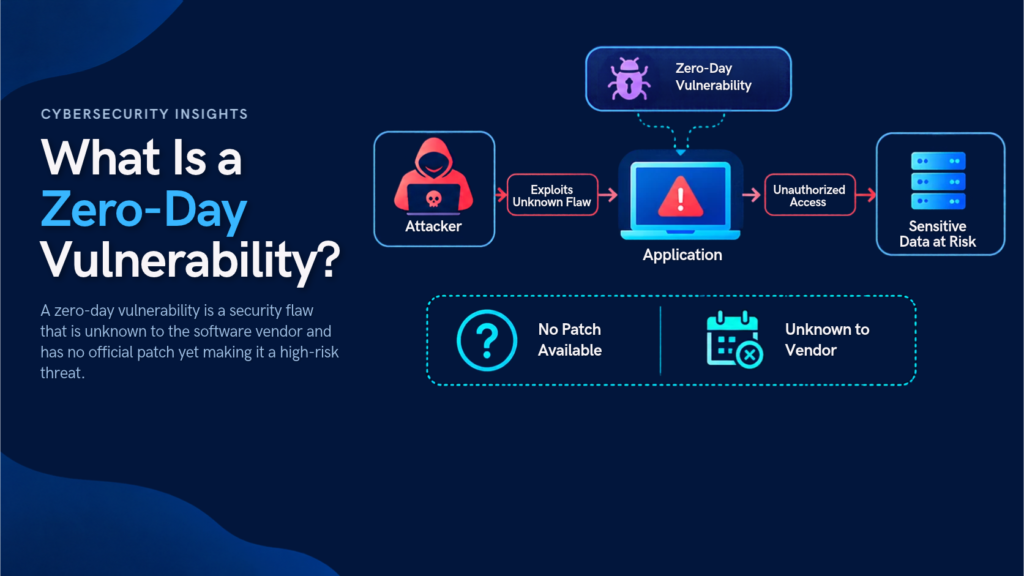
A zero-day vulnerability is a security flaw in software that the vendor does not yet know about. The name comes from the timeline: when a zero-day is actively exploited, the vendor has had zero days to prepare a fix. No patch exists. No workaround has been published. Every system running the affected software is exposed.
Zero-days sit at the most dangerous end of the vulnerability spectrum not because they are necessarily the most technically complex, but because the usual defenses do not apply. Patch management programs cannot patch what has not been patched yet. Vulnerability scanners cannot flag what has no CVE. Defenders are operating without the basic information they need to respond.
This post covers what defines a zero-day vulnerability, how they are discovered and exploited, how the lifecycle from discovery to remediation works, and what organizations can do to reduce their exposure. For security teams, development teams, and anyone responsible for a production system, zero-day risk is not hypothetical.
Key Takeaways
- A zero-day vulnerability is an unpatched flaw unknown to the vendor; no CVE, no patch, and no official guidance exists at the time of exploitation
- Zero-days are discovered by security researchers, bug bounty hunters, and threat actors, often independently and at different points in time
- The window between discovery and patch application across an organization’s fleet is when zero-day exploits cause the most damage
- Penetration testing, code review, and structured vulnerability disclosure programs reduce zero-day risk before exploitation occurs
- Responsible disclosure and VDP programs are the primary channels through which vendors receive and act on zero-day reports
What Makes a Vulnerability a Zero-Day?
The “zero-day” label describes the vendor’s position relative to the flaw, not the flaw’s technical properties. A zero-day can be any type of vulnerability: a memory corruption bug, an authentication bypass, an injection flaw, a logic error, or a configuration issue. What makes it a zero-day is that the vendor has not been informed and has had no opportunity to release a fix.
The vendor does not know it exists. A vulnerability known only to the researcher who found it, or only to the threat actor exploiting it, is a zero-day for as long as the vendor remains unaware. Once the vendor is notified and begins working on a fix, the clock on the zero-day lifecycle starts.
No patch is available. Even after a vendor acknowledges a vulnerability, the period between acknowledgment and patch release leaves users exposed. This window is sometimes called the patch gap. Zero-day status technically ends when a patch is released, though organizations that have not applied the patch remain effectively exposed to what becomes a known, exploitable vulnerability.
Active exploitation may or may not already be occurring. A zero-day being actively exploited in the wild (meaning real-world attacks, not lab environments) is the most dangerous scenario. But a zero-day that has not yet been weaponized is still a zero-day; the risk is that it will be discovered and weaponized by a threat actor before the vendor ships a fix.
Vulnerability management programs that rely on CVE feeds and patch advisories have a structural blind spot: zero-days, by definition, do not appear in those feeds until after a vendor acknowledges them. Building a risk program that accounts only for known, disclosed vulnerabilities leaves the highest-severity exposure unaddressed.
How Are Zero-Day Vulnerabilities Discovered?
Zero-days are found by different types of people for different reasons. The same flaw can be independently discovered by a security researcher, a nation-state intelligence team, and a criminal threat actor at different points in time. Who finds it first, and what they do with it, determines whether the outcome is a coordinated patch release or an exploitation campaign.
Independent security researchers find zero-days through manual code review, fuzzing, reverse engineering, and targeted analysis of high-value software. A researcher who discovers a zero-day faces a decision: report it to the vendor through responsible disclosure channels, participate in a bug bounty program if one exists, sell it to a broker, or do nothing. The incentive structures around that decision shape how many zero-days are ever disclosed to vendors.
Bug bounty programs create a direct financial incentive for researchers to report zero-days rather than hold or sell them. Bugstrix offers a bug bounty program as part of its offensive security practice, and works with organizations to structure reward tiers and scope definitions that compete with alternative markets for vulnerability information. A well-structured program with meaningful rewards consistently surfaces zero-day-class vulnerabilities that internal testing misses.
Threat actors and nation-state groups invest significant resources in zero-day discovery, both through internal research teams and through purchasing from brokers. Nation-state-level zero-days typically target operating systems, browsers, network devices, and high-value enterprise software. Criminal groups focus on vulnerabilities with broad impact across commodity software where the return scales with the number of vulnerable targets.
Responsible disclosure is the process through which researchers who discover zero-days notify vendors privately, agree on a defined window for the vendor to produce a fix, and publish only after the patch is available or the window expires. It is the mechanism that converts potential zero-day exploitation into coordinated patch releases.
What Is the Zero-Day Lifecycle?
A zero-day does not appear as a single event. It moves through a sequence of stages, and the risk level changes at each stage depending on who holds knowledge of the vulnerability and what they are doing with it.
Discovery. A researcher or threat actor identifies a vulnerability in software that the vendor does not yet know about. At this point, the zero-day exists but has not been weaponized or disclosed. The discoverer decides what to do next.
Private exploitation (threat actor path). A threat actor who discovers or purchases a zero-day uses it quietly, targeting high-value victims while maintaining the advantage of an unpatched vulnerability. Nation-state actors often hold zero-days for strategic use rather than deploying them broadly, to avoid burning the exploit before it achieves its objective.
Responsible disclosure (researcher path). A researcher who follows responsible disclosure notifies the vendor privately and agrees on a coordinated disclosure timeline. The vendor produces a patch within the agreed window, and the vulnerability details are published publicly once the patch is available. This is the lifecycle outcome that benefits the widest population of users.
Vendor acknowledgment and patch development. Once the vendor receives a report, they verify the vulnerability, assess severity, and begin patch development. The time between initial report and patch release varies from days to months depending on the complexity of the fix and the vendor’s internal processes. Bugstrix’s experience working with organizations through coordinated disclosures shows that this gap is consistently longer than expected: even straightforward fixes require testing, staging, and distribution before reaching end users.
Public disclosure and patch release. The patch is published alongside a security advisory, typically with a CVE assigned. Organizations apply the patch. Those that do so promptly close their exposure; those that do not remain vulnerable to what is now a known, documented, and publicly exploitable flaw.
Remediation window. Between public disclosure and patch application across an organization’s entire asset inventory, there is a period during which attackers with knowledge of the vulnerability can exploit it against unpatched systems. This is when the highest volume of exploitation typically occurs: the vulnerability is now public, and working exploit code is often available within hours of disclosure.
A Vulnerability Disclosure Program (VDP) is the formal structure through which organizations receive, triage, and respond to zero-day reports from external researchers. Organizations without a VDP force researchers who find vulnerabilities in their systems into a choice between silence and full public disclosure. A VDP creates the structured channel that keeps the responsible path accessible and actionable.
How Do Zero-Days Differ From Known Vulnerabilities?
The distinction matters practically, not just terminologically.
Known vulnerabilities have a CVE and often a published proof of concept. Security teams can query them, prioritize them against CVSS scores, and track their patch status in asset management systems. Automated scanners surface them. Patch management tooling addresses them. The workflow for handling known vulnerabilities is mature and well-supported.
Zero-days have none of those properties. There is no CVE to search for. Scanners return no findings. Patch management has nothing to apply. The only way to detect zero-day exploitation in progress is through behavioral anomaly detection: network traffic patterns, process behavior, file system activity, and authentication events that deviate from baseline. By the time a zero-day is confirmed through incident response, it may have been active for days, weeks, or months.
The attacker’s dwell time is longer. A threat actor exploiting a known vulnerability faces defenders who have at least the option to patch. A threat actor exploiting a zero-day faces no equivalent defensive response because the defender does not know the vulnerability exists. Confirmed dwell times in incidents involving zero-days are consistently longer than in incidents involving known vulnerabilities.
The remediation path is different. For a known vulnerability, remediation is applying a patch. For a zero-day under active exploitation before a patch exists, options are limited: network-level controls to block exploitation patterns, virtual patching through WAF or IPS rules, disabling the vulnerable feature if operationally feasible, or accepting the risk while waiting for the vendor. None of these are as reliable as a patch.
How Are Organizations Exposed to Zero-Day Risk?
Zero-day exposure is not uniform across an organization. Some assets carry substantially higher zero-day risk than others, and that risk is determined by the software running on them, the exposure of that software to external access, and the attractiveness of the organization as a target.
Externally accessible applications carry the highest zero-day exposure. A web application reachable from the public internet is accessible to any threat actor who holds a zero-day affecting its underlying framework, server, or runtime. Web application security posture determines how quickly a zero-day in the application stack translates into full compromise. Organizations with strong application security baselines, defense-in-depth controls, and anomaly detection narrow the blast radius even when a zero-day is exploited.
Third-party dependencies create inherited zero-day risk. Every library, framework, and component an application uses inherits the zero-day risk of that dependency. An organization that builds secure code on top of a vulnerable third-party library is exposed to the library’s zero-days regardless of the quality of its own code. Dependency inventory and active monitoring of third-party component security are prerequisites for managing this exposure.
Supply chain software and security tooling are high-value targets. Threat actors seeking broad access target software that runs on many systems simultaneously. Security software, monitoring agents, deployment tools, and development platform components are attractive because a single zero-day in widely deployed tooling can provide access to large numbers of organizations. Bugstrix assessments of enterprise environments consistently identify third-party tooling as an underinvestigated zero-day exposure surface.
High-value targets face more sophisticated zero-day risk. A small retailer faces different zero-day risk than a defense contractor, financial institution, or critical infrastructure operator. Nation-state zero-days are expensive to develop and use; they are deployed selectively against targets where the intelligence or financial return justifies the cost. Organizations in sectors attractive to nation-state actors should operate under the assumption that sophisticated zero-day capability exists against components of their software stack.
How Can Organizations Reduce Zero-Day Risk?
Zero-day risk cannot be eliminated: by definition, unknown vulnerabilities cannot be patched before they are known. But the exposure surface can be reduced, detection capability can be improved, and the blast radius of a successful zero-day exploitation can be limited through consistent security practice.
Penetration testing discovers zero-day-class vulnerabilities before attackers do. Understanding what penetration testing is and how it works clarifies why manual testing is required: automated scanners check for known CVEs; skilled testers check for logic errors, authentication weaknesses, and session management flaws that have no CVE because they have not yet been discovered. Bugstrix penetration testing services are structured around this manual-first methodology, with security engineers testing business logic, API behavior, and authentication flows for the exact vulnerability classes that zero-day researchers target in production systems.
Code review catches zero-day-class flaws before they ship. A vulnerability identified in code review never becomes a zero-day in production. Secure code review applied to authentication logic, data access patterns, input handling, and session management finds the same categories of flaws that zero-day researchers target externally. Bugstrix cybersecurity code review engagements routinely surface authentication bypass and injection-class vulnerabilities in custom application code that would otherwise be zero-days the moment the application reaches a public-facing environment.
Minimizing attack surface reduces the number of components that can carry zero-day risk. Every service, library, and feature an application does not need is a potential zero-day that can be eliminated by removing it. Dependency auditing, feature flagging for unused functionality, and regular decommissioning of legacy components reduce the software inventory that attackers can target.
Behavioral detection narrows the dwell time window. Since zero-days cannot be detected by signature or CVE-based scanning, detection depends on anomalous behavior. Baseline network traffic, monitor authentication events, log API call patterns, and alert on deviations from established behavior. A zero-day being actively exploited leaves behavioral traces even when no signature exists for the underlying vulnerability.
Get a quote for a penetration testing or code review engagement
Frequently Asked Questions
What does “zero-day” mean?
Zero-day refers to the number of days the software vendor has had to address the vulnerability before exploitation occurs: zero. A zero-day vulnerability is one the vendor does not know about and therefore has had no time to patch. Once a patch is released, it is no longer a zero-day from the vendor’s perspective, though organizations that have not applied the patch remain exposed.
Is a zero-day the same as a CVE?
No. A CVE (Common Vulnerabilities and Exposures) identifier is assigned to a vulnerability after it has been disclosed and acknowledged. Zero-days, by definition, have not been publicly disclosed, so they have no CVE at the time of exploitation. A zero-day receives a CVE only after the vendor acknowledges it and begins the coordinated disclosure process.
How long does a zero-day stay exploitable?
It depends on when the vendor discovers it and how quickly they patch it. Some zero-days are patched within days of being reported. Others are exploited quietly for months or years before being discovered. Confirmed dwell times in nation-state zero-day campaigns have run to multiple years in cases where the vulnerability was only discovered through post-incident forensic analysis.
Can antivirus or EDR tools detect zero-days?
Not by signature. Antivirus and EDR tools rely on known indicators of compromise, signatures, and behavioral heuristics. A zero-day exploit for which no signature exists will not trigger a signature-based detection. Modern EDR tools with behavioral analytics can sometimes identify zero-day exploitation by detecting anomalous process behavior or memory activity, but this is not guaranteed. Defense against zero-days depends on layered controls, not any single detection tool.
What is the difference between a zero-day exploit and a zero-day vulnerability?
A zero-day vulnerability is the underlying flaw in the software. A zero-day exploit is the functional code or technique that weaponizes that flaw to achieve a specific outcome: remote code execution, privilege escalation, data exfiltration. A vulnerability can exist without a working exploit; an exploit is the operationalized version of the vulnerability. In public reporting, the terms are often used interchangeably, but in security research and disclosure work the distinction matters for severity assessment.
Should organizations run a bug bounty program to address zero-day risk?
Yes, for organizations with the maturity to receive, triage, and respond to external vulnerability reports. A bug bounty program creates a structured, incentivized channel for security researchers to report vulnerabilities they find in your systems before those vulnerabilities reach threat actors. A well-scoped program with meaningful reward tiers consistently produces findings that internal testing and automated scanning do not surface.
Zero-Days and the Security Program Around Them
Zero-day vulnerabilities represent the edge of what conventional security programs can defend against. Patch management and vulnerability scanning address the known. Zero-days exist in the space those programs do not cover, by definition.
The security discipline that reduces zero-day risk is the same discipline that produces a strong posture across the board: reducing attack surface, finding vulnerabilities before attackers do through penetration testing and code review, structuring disclosure programs that bring external researchers onto the defensive side, and building behavioral detection capability that does not depend on signatures.
Bugstrix works with organizations to reduce zero-day exposure across all of those dimensions: penetration testing that goes beyond automated scanning to find logic flaws and zero-day-class vulnerabilities in custom application code, code review that catches flaws before they reach production, and bug bounty program design that creates the right incentive structures for external researchers. The organizations that invest in finding their own zero-days first consistently have shorter incident timelines and narrower blast radius when a vendor zero-day eventually affects their stack.
Contact us to discuss your zero-day risk and security testing program