What Is Dynamic Application Security Testing (DAST)?

Written By
Sarwat Iftikhar
Securing an application requires testing it from the same perspective an attacker would use. An attacker approaching a web application from the outside does not have access to your source code, your architecture diagrams, or your developer documentation. They have what is reachable through the application interface: inputs to manipulate, responses to analyze, authentication flows to probe, and business logic to test for weaknesses that the development team did not anticipate.
Dynamic Application Security Testing is the discipline of testing running applications from exactly this perspective, using automated tools to send crafted inputs, analyze responses, and identify security vulnerabilities through the application’s external interface without requiring access to the underlying code. It tests the application as deployed, under real operational conditions, in the way that an external attacker would interact with it.
DAST is one of several application security testing approaches used in modern software development and security programs. Understanding what it does well, what it cannot do, and how it fits alongside manual testing and code-level analysis is the foundation for using it effectively rather than assuming it either covers everything or is redundant with other security tools.
Key Takeaways
- DAST tests running applications from the outside by sending crafted inputs and analyzing responses, without requiring access to source code. It tests the deployed application as an attacker would approach it.
- DAST finds the vulnerability classes that manifest at runtime in running applications: injection flaws, authentication weaknesses, access control failures, misconfigured security headers, and session management issues.
- DAST cannot find vulnerabilities that require source code visibility to detect: hardcoded secrets, cryptographic implementation errors, business logic flaws, and complex authorization gaps in unexposed functions.
- In Bugstrix application security assessments, DAST tools cover broad application attack surface efficiently but consistently miss the authorization failures and business logic issues that account for the majority of critical findings. Manual testing closes that gap.
- The most effective application security programs combine DAST for automated breadth coverage with manual penetration testing for depth and business logic validation, and with static analysis or code review for code-level visibility.
What Is Dynamic Application Security Testing?
Dynamic Application Security Testing is an automated security testing approach that evaluates a running application’s security posture by interacting with it through its external interface, sending potentially malicious inputs across all discovered inputs and endpoints, and analyzing the application’s behavior and responses to identify security vulnerabilities.
The defining characteristic of DAST is that it treats the application as a black box. It does not require access to source code, configuration files, or internal architecture documentation. It works with what is externally accessible: the application’s URLs, forms, API endpoints, authentication flows, and the responses the application sends to different inputs. This black-box approach makes DAST applicable across any technology stack and deployable without developer coordination once the tool is configured.
DAST sits alongside two other primary application security testing approaches that address the same goal of finding vulnerabilities but through different mechanisms. Static Application Security Testing analyzes source code without executing it, finding vulnerabilities in the code itself before the application is deployed. Interactive Application Security Testing instruments the running application to observe internal behavior during testing, combining elements of both approaches. DAST occupies the external, runtime testing position in this landscape.
The practical role of DAST in most security programs is as an automated breadth layer that efficiently covers the known vulnerability signature landscape across the full application attack surface, running continuously in CI/CD pipelines or on defined schedules, and surfacing findings for human review and prioritization. It is fast, repeatable, and deployable at scale across large application portfolios. It is not a replacement for the depth that manual testing provides.
For a broader understanding of the web application security landscape that DAST operates within, our post on web application security covers the full range of threats and testing approaches that protect modern web applications.
How Does DAST Work?
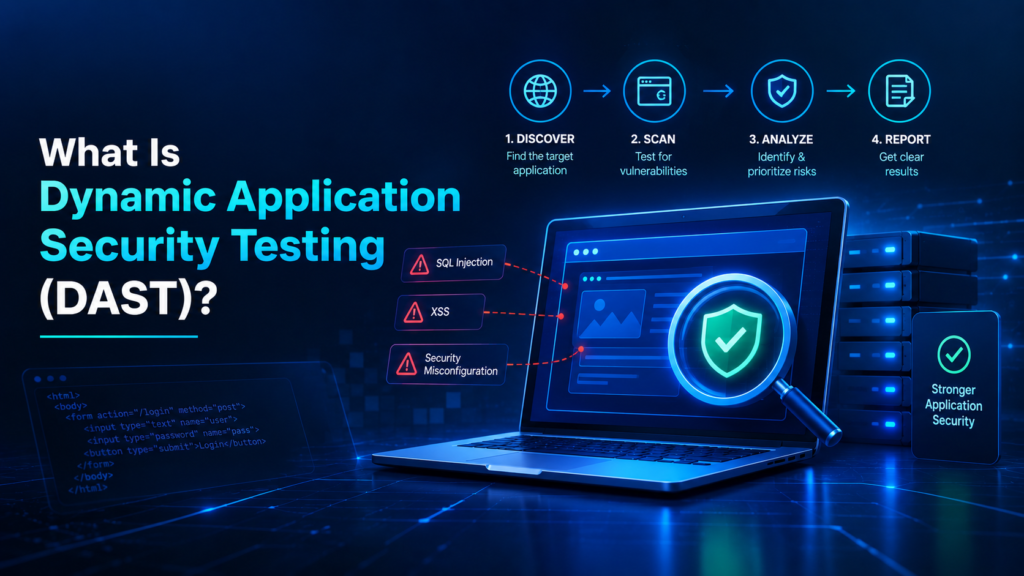
DAST works through three sequential phases: crawling the application to discover its full attack surface, attacking that surface with crafted inputs designed to trigger specific vulnerability classes, and analyzing application responses to identify vulnerabilities based on behavioral indicators such as error messages, response time anomalies, reflected input, and unexpected data disclosure.
Phase 1: Crawling and attack surface discovery. The DAST tool systematically maps the application by following links, submitting forms, discovering API endpoints, and identifying all externally accessible functionality. For modern applications with JavaScript-heavy frontends, this requires a crawling engine capable of executing JavaScript and capturing dynamically rendered content rather than just parsing static HTML. The quality of this discovery phase directly determines the coverage of the subsequent attack phase.
Phase 2: Active attack. Against each discovered input point including URL parameters, form fields, HTTP headers, and API request parameters, the DAST tool sends a battery of payloads designed to trigger specific vulnerability classes. SQL injection payloads attempt to manipulate database queries. Cross-site scripting payloads test whether user input reaches the DOM without sanitization. Command injection payloads probe for server-side command execution. Path traversal payloads test for unauthorized file system access. The breadth of the attack payload library determines which vulnerability classes the tool can detect.
Phase 3: Response analysis. The tool analyzes application responses to each payload to determine whether a vulnerability was triggered. Indicators include database error messages that confirm SQL injection, reflected payloads in HTML responses that confirm XSS, different response behaviors for inputs with and without injection characters that suggest injection vulnerability, and response headers that reveal missing security controls. The accuracy of this analysis determines the false positive rate and the value of the findings generated.
The entire process can run in an automated, unattended mode once configured, which is what makes DAST appropriate for integration into CI/CD pipelines where every build can trigger an automated security check against the deployed application.
What Vulnerabilities Does DAST Find?
DAST reliably finds vulnerabilities that manifest in application behavior at runtime through the external interface. The categories it covers effectively are the same categories that appear in standard web application vulnerability taxonomies, particularly those detectable through input manipulation and response analysis without source code access.
Injection vulnerabilities are among the highest-value DAST findings. SQL injection, command injection, LDAP injection, and XML injection vulnerabilities are detectable by submitting crafted payloads through input fields and observing whether the application response indicates the injection was processed. These are high-severity findings that DAST identifies efficiently across large application attack surfaces.
Cross-site scripting in its reflected and DOM-based forms is detectable through DAST by submitting JavaScript payloads and checking whether they appear unescaped in the application response. Stored XSS is detectable with more sophisticated approaches that track whether submitted input later appears in a different context.
Authentication and session management weaknesses including insecure session token generation, missing secure and HTTP-only cookie flags, inadequate password policies, and predictable token patterns, are identifiable through DAST by examining authentication flows and session handling behavior.
Security header misconfigurations covering Content Security Policy, X-Frame-Options, HSTS, and related headers are quickly detectable through response header analysis, producing findings that are fast to remediate and directly improve the application’s security posture.
SSRF vulnerabilities in endpoints that make server-side HTTP requests are detectable by DAST through payload injection designed to redirect those requests to attacker-controlled endpoints, confirming whether the application’s server-side request logic validates its destinations.
What DAST consistently does not find is equally important to understand. Hardcoded secrets, cryptographic implementation errors, business logic flaws that require understanding what the application is supposed to enforce, complex IDOR vulnerabilities that require cross-account testing with specific knowledge of the permission model, and vulnerabilities in code paths not reachable through the external interface all fall outside what automated dynamic testing can detect. These require either source code analysis or manual testing with application context.
What Is the Difference Between DAST, SAST, and IAST?
DAST, SAST, and IAST are three complementary application security testing approaches that address the same goal through different mechanisms. Each finds different vulnerability classes, operates at a different point in the development lifecycle, and requires different access to the application. Understanding the differences is what allows security programs to use all three effectively rather than assuming any single approach is sufficient.
SAST (Static Application Security Testing) analyzes source code, bytecode, or binary without executing the application. It operates on the code itself, finding vulnerabilities in how the code is written rather than in how the application behaves when running. SAST can find vulnerabilities before the application is deployed, which is its primary advantage: it shifts detection left in the development lifecycle. It requires source code access and generates a higher false positive rate than runtime testing because it cannot evaluate deployment context.
DAST (Dynamic Application Security Testing) tests the running application from the outside through its external interface. It requires no source code access and tests the application as deployed, finding vulnerabilities that manifest in runtime behavior. It has a lower false positive rate than SAST because findings are confirmed through actual application interaction rather than code pattern matching. It cannot find vulnerabilities that do not manifest through external interface interaction.
IAST (Interactive Application Security Testing) instruments the running application with agents that monitor internal behavior during testing, combining the runtime perspective of DAST with the code-level visibility of SAST. It typically requires integration with the application framework and produces more precise findings than either approach alone, but also requires more integration effort and framework compatibility.
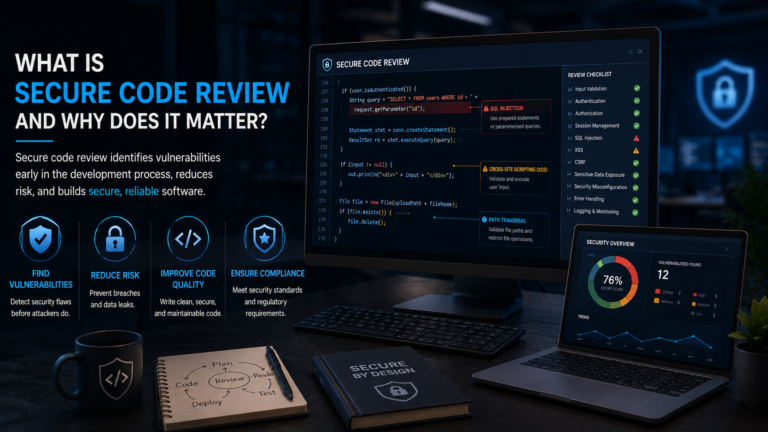
In practice, the DAST and SAST combination addresses the most common security program needs. SAST covers code-level visibility during development. DAST covers runtime behavior in deployed environments. Code review adds the human judgment layer that both automated approaches miss. Our post on secure code review covers the manual review discipline that complements automated static and dynamic testing, and our cybersecurity code review service provides that expert manual layer for organizations that need it.
How Is DAST Different from Manual Penetration Testing?
DAST and manual penetration testing both test running applications from an external perspective, without requiring source code access, in the same black-box position an external attacker would occupy. What separates them is not access to information but depth, adaptability, and the vulnerability classes each can find. DAST is automated, fast, scalable, and effective at covering known vulnerability patterns efficiently. Manual penetration testing is human-driven, adaptive, context-aware, and capable of finding the business logic flaws, authorization gaps, and chained vulnerabilities that automated testing cannot reach.
The core limitation of DAST relative to manual testing is that it operates from a fixed rulebook: a defined payload library and a set of behavioral signatures. It sends known payloads, observes known response patterns, and categorizes findings against those patterns. It cannot reason about what the application is supposed to do, does not pursue an unusual response with curiosity, and does not develop a novel test case for application-specific behavior it has not seen before.
A manual penetration tester who has been briefed on the application’s purpose, its user roles, and its business rules operates completely differently. When they notice one endpoint behaving differently from a similar one, they investigate that difference systematically. They design test cases around the specific authorization model, test whether payment flows can be manipulated in ways the code did not anticipate, check whether promo codes can be stacked beyond their intended limit, and pursue a combination of lower-severity findings toward a more serious chained vulnerability. That adaptive, curious approach is what produces the most impactful findings in any penetration test, and it is exactly what a fixed payload library structurally cannot replicate.
In Bugstrix web application assessments, authorization failures and business logic flaws consistently account for the majority of critical findings, and both are categories that DAST tools miss almost entirely. That is not a critique of DAST as a tool. It is a description of what automated testing is structurally incapable of finding, and why manual testing remains essential rather than becoming redundant as DAST tooling improves.
The practical relationship is that DAST and manual testing are complementary rather than competitive. Our post on manual vs automated penetration testing covers this relationship in detail. Our web application penetration testing services provide the manual depth that DAST cannot supply, specifically covering the authorization, business logic, and chained vulnerability categories that automated testing leaves uncovered.
Where Does DAST Fit in the CI/CD Pipeline?
DAST in a CI/CD pipeline provides automated security feedback on every build, catching regression vulnerabilities that new code introduces before they reach production. This is where DAST’s speed and automation advantages over manual testing are most clearly valuable. A manual penetration test cannot be run on every commit. DAST can.
The integration model for DAST in CI/CD typically works as follows. A lightweight DAST scan runs against a deployed instance of the application in a staging or testing environment as part of the build pipeline. Findings above a defined severity threshold fail the build or generate alerts that require review before the build progresses to production. Findings below the threshold are logged for tracking without blocking the pipeline.
The key challenge in CI/CD DAST integration is configuring the tool to work effectively with modern web applications. Applications with complex JavaScript frontends require a DAST tool capable of executing JavaScript during crawling. Applications with authenticated functionality require the tool to handle login flows and maintain session state throughout the scan. APIs that use non-standard authentication mechanisms require custom authentication configuration. These integration requirements mean that DAST in CI/CD requires upfront configuration investment before it produces reliable, low-noise results.
The appropriate severity threshold for build blocking also requires judgment. Blocking every build on any DAST finding produces alert fatigue and slows development velocity. Blocking only on critical and high findings with minimal false positives maintains security signal quality while keeping the pipeline moving. This calibration is specific to each application and evolves as the false positive rate of the configured DAST tool is measured over time.
Our continuous penetration testing services integrate automated scanning with manual testing oversight in exactly this continuous model, providing the ongoing coverage that CI/CD-integrated DAST supports and the manual depth that automated testing alone cannot supply.
Does DAST Apply to Mobile Applications and APIs?
DAST applies to mobile applications and APIs through the network traffic layer that mobile apps generate and the API endpoints they communicate with. The mobile app itself, the code running on a device, requires different testing methodology. The backend APIs, authentication services, and data endpoints the mobile app communicates with are testable through DAST because they expose standard HTTP-based interfaces.
For mobile application security programs, DAST against the backend API infrastructure provides automated coverage of the server-side attack surface that the mobile app communicates with. Injection vulnerabilities, authentication weaknesses, and access control failures in the API layer are detectable through DAST regardless of whether the client is a web browser or a mobile app.
The device-side attack surface of a mobile application, including local data storage, certificate handling, binary protections, and inter-app communication, requires dedicated mobile application security testing rather than DAST. Our post on mobile application penetration testing covers the testing methodology for the device-side attack surface that DAST does not reach. Our mobile app penetration testing services address both the device-side and the API-side testing needs of mobile applications in a combined engagement.
What Are the Limitations of DAST?
DAST has several significant limitations that security programs need to account for when deciding how to use it and what to supplement it with. Understanding these limitations prevents the assumption that DAST coverage is equivalent to comprehensive application security testing.
Authentication complexity. DAST tools that cannot handle modern authentication flows, including OAuth, multi-factor authentication, CAPTCHA, and complex session management schemes, will fail to test authenticated application functionality effectively. Unauthenticated testing covers only the publicly accessible attack surface, which is typically a minority of the total attack surface for applications with authenticated functionality.
Modern application architecture challenges. Applications built on single-page application frameworks, GraphQL APIs, and WebSocket communication present crawling and testing challenges for DAST tools designed around traditional web application architectures. Tools that cannot interpret JavaScript-rendered content miss the significant portions of modern web application attack surface that are not present in initial HTML responses.
False positives. DAST tools generate false positive findings that require human review to validate. The false positive rate varies significantly between tools and is heavily influenced by how well the tool is configured for the specific application. Unvalidated DAST findings routed directly to development teams without security review reduce confidence in the tool and increase remediation effort for issues that are not real vulnerabilities.
Business logic blindness. DAST cannot test business logic, application-specific authorization models, or the vulnerability classes that require understanding what the application is supposed to do. This is a fundamental capability boundary rather than a configuration problem.
Scope of coverage. DAST testing is limited to the attack surface the tool discovers through crawling. Functionality that is not reachable through normal navigation flows, that requires specific user state to access, or that is only available through API endpoints not discoverable through crawling may not be tested.
These limitations are why DAST belongs as one layer in a multi-layered application security program rather than as the primary or sole security testing approach. Our post on vulnerability assessment vs penetration testing explains how different testing approaches address different aspects of application security risk and where each belongs in a complete program. Our vulnerability assessment services provide the broader vulnerability identification layer that complements targeted DAST scanning within an integrated security program.
How Should a Program Sequence These Layers as It Matures?
The layers covered in this post, static analysis, DAST, manual penetration testing, and continuous retesting, are usually adopted in a specific order as an application security program matures, and the order matters more than most teams initially assume. Building them in the wrong sequence is a common, avoidable way organizations end up disappointed in tools that were never the problem.
Start with DAST or a foundational vulnerability assessment, not manual testing. An organization with no prior application security testing typically has enough basic, easily-found issues, missing headers, outdated components, weak session handling, that an automated first pass clears a large volume of low-hanging findings cheaply. Committing a manual tester’s time to an environment that has never been scanned means paying expert rates to find issues a tool would have caught in minutes.
Add manual penetration testing once the automated backlog is under control. A manual engagement run against an environment still full of basic DAST-detectable findings buries the high-value authorization and business logic findings in a long list of routine issues. Clearing the automated layer first means the manual engagement’s time is spent almost entirely on the vulnerability classes only a human can find.
Layer in static analysis and code review once development velocity justifies shifting detection left. Static analysis pays off most for teams shipping code frequently enough that catching an issue before deployment, rather than after, meaningfully reduces remediation cost. Earlier-stage products with infrequent releases often get more value per hour invested from DAST and periodic manual testing than from standing up a static analysis pipeline.
Add continuous retesting once the foundation is stable. Continuous coverage between annual cycles is valuable, but it assumes the underlying DAST configuration is already tuned and the manual testing relationship is already established. Adding continuous monitoring before either of those is in place mostly produces more findings for a triage process that is not yet ready to act on them.
Getting this sequence backwards, most commonly investing in continuous or static tooling before the basics are covered, is one of the more common reasons an application security program feels expensive without feeling effective. The tools are rarely the issue. The order they were adopted in usually is.
Frequently Asked Questions
Is DAST the same as a vulnerability scan?
DAST and vulnerability scanning both use automated tools to identify security issues without manual exploitation, but they address different scope. Vulnerability scanning typically targets infrastructure: identifying known CVEs in software versions across servers and network devices. DAST specifically targets running web applications and APIs, sending crafted inputs and analyzing application behavior to identify vulnerabilities in the application logic layer that infrastructure scanning does not reach.
Can DAST replace a penetration test?
No. DAST provides automated coverage of known vulnerability patterns efficiently at breadth. A penetration test provides human-driven depth, including business logic testing, authorization validation, chained vulnerability development, and the creative adversarial thinking that finds the issues automated tools miss. Most compliance frameworks that require penetration testing, including PCI DSS and SOC 2, will not accept DAST output as a substitute for manual penetration test evidence.
How often should DAST be run?
In a CI/CD integration, DAST runs on every build or deployment, providing continuous security feedback on application changes. For organizations without CI/CD integration, weekly or monthly scheduled scans against staging or production environments maintain coverage between annual manual penetration test cycles. The higher the frequency of application changes, the more frequently DAST should run to catch vulnerabilities introduced by new code before they accumulate.
What is the difference between DAST and a web application firewall?
A web application firewall is a runtime protection control that monitors and filters incoming requests to block known attack patterns before they reach the application. DAST is a testing tool that proactively identifies vulnerabilities in the application by simulating attacks in a controlled testing environment. They address the same threat category from different directions: WAF blocks attacks against known patterns in production, and DAST finds vulnerabilities before they are attacked by testing the application before and during production deployment.
Does DAST work on APIs as well as web applications?
Yes. Modern DAST tools support both traditional web application testing and REST, GraphQL, and SOAP API testing. API DAST requires the tool to be configured with API schema information, such as an OpenAPI specification, and appropriate authentication configuration. Without schema information, API DAST relies on discovery techniques that may miss endpoints not linked from the application interface.
Automated Breadth, Manual Depth, Complete Coverage
DAST is a genuinely valuable tool in an application security program. It catches injection vulnerabilities, authentication weaknesses, and security misconfigurations efficiently across large application attack surfaces at a cadence that manual testing cannot match. In CI/CD pipelines, it provides continuous regression testing that catches security issues introduced by new code before they reach production.
What DAST is not is complete security. The vulnerability classes that cause the most serious real-world breaches, authorization failures, business logic flaws, complex IDOR vulnerabilities, and chained attack paths that combine multiple moderate findings into a critical exploit, are the ones that automated dynamic testing consistently does not find. Those require a human tester who understands the application, its users, and its business rules, and who can design test cases around that understanding.
The programs that use DAST most effectively are the ones that understand this clearly and build their security testing accordingly: DAST for automated breadth, manual penetration testing for depth, static analysis for code-level visibility, and ongoing continuous testing to maintain coverage as the application evolves. Each layer covers what the others miss. Together, they produce the comprehensive application security posture that any single approach alone cannot deliver.