What Is API Security Testing?

Written By
Sarwat Iftikhar
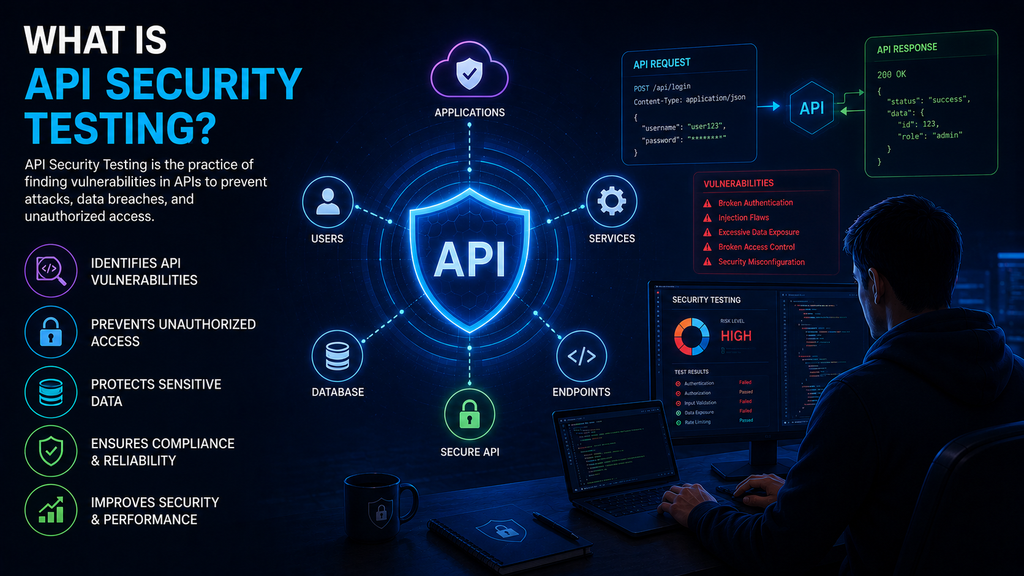
API security testing is a structured assessment that identifies exploitable vulnerabilities in the interfaces that applications use to communicate with each other, their backends, and third-party services. It covers how APIs authenticate requests, authorize access to data, validate inputs, handle errors, and enforce the business rules that govern what each caller is allowed to do.
APIs are no longer a secondary concern in application security. They are the primary one. Over 80% of internet traffic now comes from API calls, not traditional web page requests. The application you see in a browser or a mobile app is a rendering layer. The actual business logic, data access, and authorization decisions happen behind an API. Which means the vulnerabilities that cause real breaches happen there too.
API-related breaches accounted for 43% of all data breaches in 2025, a 12% increase year over year. Thirty-seven percent of organizations experienced an API security incident in 2024, more than double the rate from the year before. Despite that, only 7.5% of organizations have dedicated API security programs. The gap between how much is at risk and how seriously it is being tested is one of the defining security problems of 2026.
Key Takeaways
- API security testing is a manual assessment of authentication, authorization, input validation, and business logic across REST, GraphQL, and gRPC interfaces, not just a scan of documented endpoints.
- API-related breaches accounted for 43% of all data breaches in 2025, yet only 7.5% of organizations have dedicated API security programs.
- The OWASP API Security Top 10 defines the most commonly exploited vulnerability categories. Broken Object Level Authorization (BOLA) is the most impactful single finding class in commercial API testing.
- Automated scanners cannot find the API vulnerabilities that cause real breaches. Authorization failures, business logic flaws, and broken object property access require human testers with authenticated context.
- Shadow APIs, undocumented endpoints that exist in production but are not in the official specification, are one of the most consistently exploited entry points in modern applications.
Why Are APIs the Most Exploited Attack Surface in Modern Applications?
APIs are the most exploited attack surface in modern applications because they provide direct, programmatic access to an application’s data and functionality, often with weaker security controls than the UI layer that sits in front of them. Where a web interface enforces authorization through frontend logic and server-side middleware, an API endpoint often exposes the same functionality with fewer checks because it was built with the assumption that only legitimate clients would call it.
That assumption fails under adversarial conditions. Any authenticated user who examines network traffic from a web or mobile application can identify the underlying API endpoints. Once those endpoints are known, they can be called directly without going through the UI that enforces the authorization check. This is why authorization vulnerabilities that appear impossible through a well-built frontend are trivially exploitable at the API layer.
The volume of APIs in production compounds the problem. Modern applications use dozens of APIs: internal microservices, third-party integrations, partner APIs, legacy versioned endpoints left running after newer versions launched, and development endpoints accidentally left exposed in production. Organizations frequently lack a complete inventory of their own API surface. What you cannot enumerate, you cannot test. What you do not test, attackers find.
The commercial consequence is concrete. The most significant data breaches of the past two years, involving millions of exposed records across financial, healthcare, and SaaS environments, trace back to a handful of well-documented API vulnerability categories that competent testing would have surfaced before attackers did. These are not exotic, novel attack techniques. They are predictable failures in how APIs enforce authorization, and they remain prevalent because most organizations are still not testing their APIs with the depth and methodology the risk warrants.
What Is the OWASP API Security Top 10?
The OWASP API Security Top 10 is the industry-standard classification of the most critical and commonly exploited API vulnerability categories. First published in 2019 and updated in 2023, it remains the definitive reference framework for what an API security test should cover and how identified vulnerabilities should be categorized and prioritized.
Broken Object Level Authorization (BOLA), ranked first, is the most commercially impactful API vulnerability class in practice. It occurs when an API endpoint accepts an object identifier as a parameter and returns the corresponding data without confirming that the requesting user is authorized to access that specific object. An attacker who can call GET /invoices/1247 and receives a valid response can incrementally change that ID and read records belonging to other users or tenants. In multi-tenant SaaS environments, a single BOLA vulnerability can expose every customer’s data simultaneously.
Broken Authentication at position two covers weaknesses in how APIs verify the identity of callers. This includes missing authentication on endpoints that should require it, authentication tokens that never expire or cannot be revoked, weak token signing configurations, and authentication flows where the token is validated client-side rather than confirmed server-side on every request.
Broken Function Level Authorization (BFLA) at position five is BOLA’s sibling at the function level. Rather than accessing data belonging to another user, BFLA allows a lower-privileged user to call functions intended for administrators or higher-privilege roles. An API that grants admin capabilities to any authenticated caller who knows the endpoint path, regardless of their role, is a textbook BFLA vulnerability.
The full OWASP API Security Top 10 framework is available on the OWASP API Security project page and serves as the standard test plan for any credible API security assessment.
What Does API Security Testing Actually Cover?
API security testing covers authentication mechanisms, object-level and function-level authorization, input validation across every parameter type, rate limiting and resource consumption controls, error handling and information disclosure, business logic enforcement, and the security of the API specification itself, including undocumented and deprecated endpoints. The scope of a thorough assessment goes significantly further than testing the endpoints listed in a Swagger or OpenAPI specification.
The specific coverage areas a complete API security test addresses:
Authentication testing examines every authentication mechanism the API uses: API keys, JWT tokens, OAuth 2.0 flows, session cookies, and basic authentication where it still exists. Testing covers whether authentication can be bypassed by omitting the token, whether token validation is performed server-side on every request, whether tokens expire and can be revoked, and whether the JWT signing algorithm can be manipulated to generate valid tokens without knowing the secret.
Authorization testing is the most time-intensive and highest-impact component of API security testing. Every endpoint that accepts an object identifier is tested with identifiers belonging to other users, other roles, and other tenants to confirm that the API enforces ownership checks independently rather than relying on the calling client to limit what it requests. Function-level authorization is tested by calling privileged endpoints from lower-privilege accounts.
Input validation testing covers injection vulnerabilities across all parameter types: query strings, path parameters, request bodies (JSON, XML, form data), HTTP headers, and file uploads. This includes SQL injection, NoSQL injection, command injection, template injection, and XML external entity attacks, testing each in the context of how the API actually processes that input rather than through generic payloads that do not reflect the application’s behavior.
Business logic testing examines how the API enforces its own rules. Can a promo code be applied multiple times? Can a payment amount be sent as a negative value? Can a workflow be triggered out of sequence? Can rate-limited operations be bypassed by distributing requests across multiple accounts? These tests require understanding what the application is supposed to do, which is why they cannot be automated.
Shadow API discovery systematically identifies endpoints that exist in the running application but are absent from the official documentation. This includes deprecated API versions left running after newer versions launched, internal endpoints accessible from external networks, and endpoints exposed through error messages, JavaScript bundles, or mobile app binaries that were not intended to be public.
For a deeper look at the specific API security testing component that most organizations skip entirely, our post on the API security testing part everyone skips covers the shadow API discovery and undocumented endpoint testing methodology in detail.
How Is API Security Testing Different From Web Application Penetration Testing?
API security testing and web application penetration testing overlap significantly but differ in methodology, tooling, and the vulnerability categories that each prioritizes. Web application testing starts with a browser-rendered interface and examines the full user experience layer. API security testing starts with the API specification and traffic, examines the underlying data and logic layer directly, and specifically looks for vulnerabilities that the UI layer may mask.
The most important practical difference is scope. A web application test that follows the visible user interface finds vulnerabilities in what the application presents to users. An API test that independently enumerates and tests every endpoint, including those not accessible through the UI, finds vulnerabilities in what the application actually does at the data layer. In modern applications, these are not the same thing. The API frequently exposes more functionality than the UI renders, with fewer of the authorization checks that the UI enforces on top.
The tooling differs as well. Web application testing relies heavily on browser-based proxy interception and HTML-aware tools that understand how web pages render and submit forms. API testing relies on direct HTTP client tools, API-specific interception proxies, and schema-aware fuzzing that generates meaningful test inputs based on the API specification rather than generic web payloads.
For applications with a web frontend, the two assessments are complementary. A web application test covers the frontend-specific vulnerabilities: reflected and stored XSS, CSRF, clickjacking, DOM-based vulnerabilities, and the UI-specific authorization logic. An API test covers the backend vulnerabilities: BOLA, BFLA, mass assignment, and the server-side logic failures that the frontend never exposes directly.
Our web app penetration testing services cover the frontend layer that API testing does not, and both assessments together provide comprehensive coverage of a modern web application’s full attack surface.
How Are REST, GraphQL, and gRPC APIs Tested Differently?
REST, GraphQL, and gRPC APIs have different structures that require different testing approaches, even though the underlying vulnerability categories they share are the same. A tester who applies REST-specific methodology to a GraphQL or gRPC API will miss the architecture-specific vulnerabilities that each protocol introduces.
REST API testing is the most straightforward because the attack surface is enumerable. URL paths and HTTP methods define endpoints, and a combination of documentation review, traffic analysis, and fuzzing can produce a reasonably complete inventory of what exists. The primary testing challenges are authorization testing at scale (testing every endpoint with every role combination) and shadow endpoint discovery for APIs where the documentation is incomplete or outdated.
GraphQL API testing requires a different approach because a single GraphQL endpoint handles all requests. The attack surface is defined by the schema rather than by URL paths, and the same endpoint can return vastly different data depending on the query it receives. GraphQL-specific risks include introspection queries that expose the full schema to any caller, batch query attacks that bypass rate limiting by combining multiple operations in a single request, nested query depth attacks that consume disproportionate server resources, and field-level authorization failures where a caller can request fields on an object that their role should not be able to access.
gRPC API testing requires intercepting and decoding Protocol Buffer (protobuf) traffic, which is binary rather than text-based. This makes standard proxy interception tools insufficient without protobuf schema support. gRPC testing covers the same authorization and input validation categories as REST, but requires specialized tooling and the protobuf schema files to decode traffic meaningfully.
For organizations deploying mobile applications that communicate with REST or GraphQL backends, the API layer is often where the most impactful vulnerabilities in the mobile attack surface live. Our mobile app penetration testing services include backend API testing as a standard component, because the mobile client is frequently the most direct path to the API endpoints that matter most.
If you are ready to scope an API security assessment for your application, get a free quote and we will confirm which API types, authentication mechanisms, and endpoint coverage your engagement needs to include.
Can Automated Tools Find API Security Vulnerabilities?
Automated tools find a meaningful fraction of API security vulnerabilities, primarily those that match known patterns, but miss the most impactful vulnerability categories that require human testing with authenticated context and application-specific knowledge. Organizations that rely exclusively on automated API security scanning are consistently discovering at breach time that the vulnerabilities that caused the incident were not in the scanner’s output.
The vulnerabilities automated tools find reliably: missing security headers, known CVEs in identified API frameworks and dependencies, unauthenticated endpoints that should require authentication, basic injection signatures in documented parameters, and some misconfiguration patterns from static analysis of the API specification.
The vulnerabilities automated tools cannot find: BOLA and IDOR (requires testing with multiple authenticated accounts and knowing which objects belong to which users), BFLA (requires understanding the application’s privilege model to know which endpoints should be restricted), unrestricted access to sensitive business flows (requires understanding the business rules the application is supposed to enforce), and mass assignment (requires understanding which object fields are supposed to be writable by each role).
The pattern in the 2025 penetration testing data is unambiguous. The findings with the highest severity and the most significant real-world breach potential are concentrated in the categories that automated tools do not cover. Running automated API scanning alongside a manual API security test is good practice. Substituting one for the other is how organizations end up discovering BOLA vulnerabilities through breach disclosure rather than through their own security program.
For organizations that want to understand how API-specific vulnerability assessment compares to broader penetration testing in scope and methodology, our vulnerability assessment services page covers where each assessment type fits in a layered security program.
When Should API Security Testing Be Conducted?
API security testing should be conducted before an API goes to production, after any change to authentication or authorization logic, after adding new endpoints or data models, and at minimum annually as part of a continuous security program. The deployment velocity of modern APIs makes the timing of testing as important as the testing itself.
The specific triggers that should prompt an immediate API security assessment:
Pre-production release. Any API that has not been independently tested before it handles production traffic has not been secured. It has been deployed with unknown vulnerabilities. The cost of finding and fixing a BOLA vulnerability before launch is a fraction of the cost of managing a data breach notification process after it.
Major feature releases. New endpoints, new data models, new authentication mechanisms, and new third-party integrations each change the API’s authorization surface. A previous assessment does not tell you whether the new features are correctly enforcing access controls.
New API version launches. When a v2 API launches and v1 is supposed to be deprecated, the deprecation process frequently goes incomplete. Old endpoints left running with known vulnerabilities that were patched in the new version are one of the most consistently exploited attack vectors in modern applications.
SaaS product launch preparation. For SaaS companies preparing to launch a product, API security is a foundational component of the pre-launch security checklist. Our SaaS security checklist covers what needs to be tested at the API layer before a product goes live.
Compliance deadlines. PCI DSS v4.0 explicitly includes API endpoints that interact with the Cardholder Data Environment in its testing scope. SOC 2 auditors increasingly ask specifically about API security testing as part of CC4.1 monitoring activities evidence.
A broad understanding of penetration testing methodology and what the full testing lifecycle looks like can be found in our complete guide to penetration testing in 2026, which covers how API testing fits within a broader security assessment program.
Our penetration testing services cover API security as a core component of every web application engagement, with methodology aligned to the OWASP API Security Top 10 and the specific architecture of the API under test.
Frequently Asked Questions
What is the difference between API security testing and API penetration testing?
The terms are often used interchangeably, and the distinction matters less than the methodology. API penetration testing typically implies an active, adversarial assessment where a human tester attempts to exploit identified vulnerabilities to confirm real-world impact. API security testing is a broader term that can include automated scanning, manual testing, and code-level review. For compliance purposes and genuine risk reduction, what matters is that the assessment includes manual testing by a human tester with authenticated access, not just automated tool output.
What is BOLA and why is it consistently the most impactful API vulnerability?
BOLA stands for Broken Object Level Authorization. It occurs when an API endpoint accepts an identifier for a data object and returns or modifies that object without confirming that the authenticated caller is authorized to access it specifically. If an API allows any authenticated user to access any record by simply providing its identifier, every record in the system is accessible to every user. In multi-tenant SaaS applications, BOLA means one customer can access another customer’s data. It is consistently the most impactful finding because it is the most direct path to a multi-party data breach from a single exploitable endpoint.
Can API security testing be done without access to the source code?
Yes. Black-box API security testing works from the API specification, intercepted traffic, and active enumeration of the endpoint surface. Grey-box testing, where the tester receives the API documentation and valid credentials but not source code, is the most common model for third-party API security assessments and provides sufficient context to test authorization, authentication, and business logic thoroughly. Source code access (white-box testing) adds the ability to trace data flows and identify vulnerabilities in code paths that external testing does not reach, but is not required for a productive assessment.
How long does an API security test take?
A focused API security test covering a single service with a defined endpoint inventory typically takes one to two weeks for the testing phase. Larger engagements covering multiple APIs, microservice architectures, or multi-version endpoint inventories run two to four weeks. The testing timeline depends primarily on the number of unique endpoints, the complexity of the authentication and authorization model, and the number of user roles and object types that need to be covered in authorization testing.
Does API security testing cover mobile app backend APIs?
Yes, and mobile app backend APIs deserve specific attention because mobile clients are easier for attackers to intercept and manipulate than browser-based clients. An attacker who extracts a mobile app binary, bypasses certificate pinning, and proxies the app’s traffic has direct access to every API call the app makes. This makes the backend APIs that mobile apps rely on a higher-risk category than equivalent web APIs, because the client is not under the developer’s control. Testing the mobile backend API in conjunction with the mobile app provides complete coverage of the mobile attack surface.
API Security Is Not Optional in 2026
The data from 2025 is clear on this point. Forty-three percent of data breaches were traced to API vulnerabilities. Thirty-seven percent of organizations experienced an API security incident. Yet only 7.5% have dedicated API security programs. That gap is not a sign that organizations have evaluated API security and decided the risk is acceptable. It is a sign that most organizations have not yet updated their security program to reflect where their actual attack surface lives.
Modern applications are their APIs. The business logic, the data, the authorization decisions, and the integration points that create value and handle risk are all behind the API layer. Testing the frontend while treating the API as an afterthought is not a security program. It is a gap that motivated attackers have already learned to exploit systematically.
API security testing is the mechanism that closes that gap. It requires human testers, authenticated context, application-specific knowledge, and methodology aligned to the OWASP API Security Top 10. What it produces is an accurate picture of whether your APIs enforce the authorization rules that your application’s security depends on, before an attacker demonstrates that they do not.
Contact us to discuss an API security assessment for your application