SOC 2 vs ISO 27001: Key Differences and Which One Your Business Needs in 2026

Written By
Sarwat Iftikhar
The question comes up at a predictable moment. An enterprise prospect asks for your security certifications, or an investor requests evidence of your information security program, and suddenly the debate between SOC 2 and ISO 27001 becomes urgent.
Both frameworks protect customer data and signal security maturity to the market. Both require annual security testing that most organizations get structurally wrong. And both are increasingly treated as non-negotiable by enterprise buyers, with 65% of organizations now reporting that customers, investors, and suppliers require more compliance demonstration than in previous years.
Where they differ is in who recognizes them, how they are structured, what they require you to build, and which markets they unlock. Getting that decision wrong costs time and money in the best case, and a failed enterprise deal in the worst.
This guide breaks down the real differences between SOC 2 and ISO 27001, explains what each framework requires from a security testing perspective, and gives you a clear framework for making the right choice for your business in 2026.
Key Takeaways
- SOC 2 is the standard for US enterprise sales. ISO 27001 is the globally recognized standard required for European, government, and international markets.
- Neither framework explicitly mandates penetration testing, but auditors for both overwhelmingly expect it as evidence that security controls work in practice.
- ISO 27001 has 93 controls across Annex A compared to SOC 2’s 64 common controls, but 70-80% of controls overlap between the two frameworks.
- ISO 27001 typically costs 1.5-2x more than SOC 2 and takes longer to implement, but produces a globally recognized certificate valid for three years.
- Organizations pursuing both frameworks simultaneously can reuse 70%+ of their security controls, policies, and evidence, making dual compliance more efficient than sequential certification.
- In Bugstrix compliance engagements, authorization failures and access control weaknesses are the most common critical findings regardless of which framework is in scope.
What Is SOC 2 and What Does It Actually Certify?
SOC 2 is a compliance framework developed by the American Institute of Certified Public Accountants that certifies how a service organization protects customer data. It produces an attestation report issued by a licensed CPA firm confirming that your security controls meet the Trust Services Criteria relevant to your business. It does not produce a certification; it produces a report that customers request during vendor security reviews.
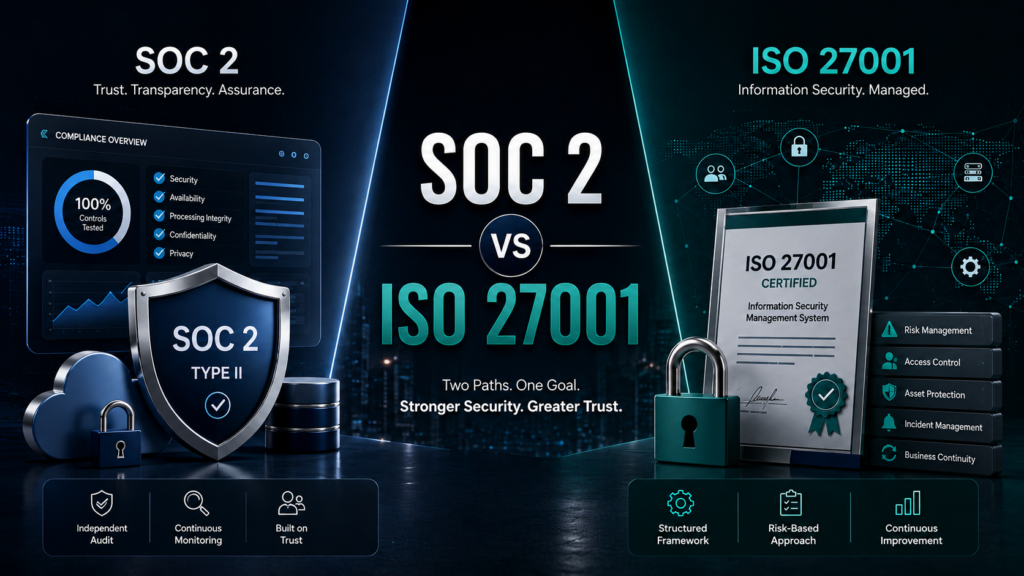
SOC 2 evaluates organizations against five Trust Services Criteria: Security, Availability, Processing Integrity, Confidentiality, and Privacy. Security is mandatory in every audit. The remaining four are selected based on what your services commit to. The framework is outcomes-based, meaning it defines what your controls must demonstrate rather than prescribing exactly which controls to implement.
This flexibility is one of SOC 2’s practical advantages for earlier-stage companies. You design controls appropriate for your environment rather than implementing a fixed set regardless of your actual risk profile. The tradeoff is that the framework is heavily recognized in North America and by US enterprise buyers, and carries limited recognition outside that market.
SOC 2 comes in two types. Type I assesses whether your security controls are suitably designed at a specific point in time. Type II assesses whether those controls operated effectively over a six-to twelve-month observation period. Enterprise buyers almost universally require Type II because it demonstrates sustained security posture, not a one-time snapshot.
What Is ISO 27001 and How Does It Differ from SOC 2?
ISO 27001 is an internationally recognized standard published by the International Organization for Standardization that requires organizations to establish, implement, maintain, and continually improve an Information Security Management System. Unlike SOC 2, which produces an attestation report, ISO 27001 produces a binary certificate: you either meet the requirements or you do not. That certificate is valid for three years, with mandatory annual surveillance audits.
The structural difference between the two frameworks is significant. ISO 27001 requires organizations to build and document a formal ISMS that governs how security is managed across the entire organization, not just within a defined system boundary. The 2022 revision of the standard includes 93 controls across Annex A, organized into four themes: Organizational, People, Physical, and Technological. Organizations determine which controls apply through a formal risk assessment and document their decisions in a Statement of Applicability.
ISO 27001 is the framework recognized globally. If your business operates in European markets, sells to government agencies, handles regulated data under GDPR-adjacent requirements, or pursues customers in Asia Pacific or the Middle East, ISO 27001 carries the credibility that SOC 2 does not. Organizations that need to demonstrate security compliance across multiple international markets typically have no practical alternative to ISO 27001.
The management system emphasis also means ISO 27001 requires more organizational change than SOC 2. It is not just about having the right controls. It is about having a documented system for managing security as an ongoing organizational function, with governance, ownership, review cycles, and continuous improvement built into the structure.
What Are the Key Differences Between SOC 2 and ISO 27001?
SOC 2 and ISO 27001 differ across five dimensions that determine which one is right for a specific business: geographic market recognition, framework structure, audit output, control requirements, and ongoing maintenance burden.
The most important practical differences to understand:
Geographic reach. SOC 2 is understood by US enterprise procurement teams and investors. It carries limited recognition in European, government, and international markets. ISO 27001 is recognized globally and is often a hard requirement for doing business in Europe or with government bodies. If you are a US SaaS company selling only to US customers, SOC 2 is typically sufficient. If you have international ambitions, ISO 27001 becomes necessary at some point.
Framework philosophy. SOC 2 is outcomes-based. You define how you meet the Trust Services Criteria. ISO 27001 is more prescriptive. The 93 Annex A controls define what you need to have in place, and you document which ones apply to your environment and why through a Statement of Applicability. ISO 27001 requires more organizational change to implement, but produces a more comprehensive and portable security program.
Audit output. SOC 2 produces a report that you share with customers under an NDA. ISO 27001 produces a certificate that is publicly verifiable. For some buyers, the publicly verifiable certificate carries more weight. For others, the detailed SOC 2 report with specific control evidence is more useful.
Ongoing commitment. SOC 2 Type II requires annual renewal with a new observation period each time. ISO 27001 is certified for three years with annual surveillance audits that are less intensive than the full certification. Long-term, ISO 27001 can be more efficient for organizations that achieve it, but the upfront investment is significantly higher.
Which Framework Requires More Rigorous Penetration Testing?
Both SOC 2 and ISO 27001 require penetration testing in practice, even though neither framework explicitly mandates it by name. The penetration testing requirements embedded in each framework are comparable in scope but differ in how they are structured and what evidence auditors specifically look for.
For SOC 2, penetration testing maps primarily to CC4.1 (Monitoring Activities) under the Trust Services Criteria. Auditors expect evidence that controls are tested under real-world adversarial conditions, and a scoped third-party penetration test with documented remediation is the most accepted form of that evidence. The test must fall within the audit observation period for Type II, with retest evidence confirming that identified findings were remediated.
For ISO 27001, penetration testing maps to two specific Annex A controls in the 2022 revision. Annex A.8.8 (Management of Technical Vulnerabilities) requires organizations to identify, evaluate, and act on technical vulnerabilities. Annex A.8.29 (Security Testing in Development and Acceptance) requires security testing to be defined and performed across the development lifecycle. Clause 9.1 further requires monitoring, measurement, analysis, and evaluation of the ISMS. Together, these make penetration testing effectively mandatory in practice, even though the word never appears in the standard.
The practical difference is in evidence documentation. ISO 27001 requires the penetration test evidence to be mapped explicitly to the Annex A controls it addresses and integrated into the ISMS documentation. SOC 2 requires mapping to Trust Services Criteria. In both cases, an automated vulnerability scan without human validation is rejected as insufficient evidence.
What does not change between the two frameworks is the finding categories that matter most. In our experience across both SOC 2 and ISO 27001 compliance engagements at Bugstrix, authorization failures, access control weaknesses, and business logic vulnerabilities are the most common critical findings regardless of which framework is in scope. These are also the findings that automated scanners most consistently miss, which is why auditors for both frameworks have moved away from accepting scan-only reports.
For a clear explanation of how penetration testing differs from vulnerability assessment and why that distinction matters for compliance evidence, our post on vulnerability assessment vs penetration testing covers the difference in detail.
Our penetration testing services are structured to produce audit-ready evidence for both SOC 2 and ISO 27001 engagements.
Does Your Customer Base Determine Which Framework You Need?
Yes, your customer base is the single most reliable indicator of which framework to prioritize. The compliance framework your customers and prospects require in their vendor security questionnaires is more important than any general recommendation about which standard is better.
The market segmentation is fairly consistent across industries:
US-focused SaaS companies selling to US enterprise customers are almost universally asked for a SOC 2. The framework is deeply embedded in US enterprise vendor management processes, and US procurement teams understand it. A SOC 2 Type II report typically unblocks more US enterprise deals than an ISO 27001 certificate.
Companies selling into European markets will encounter ISO 27001 as a hard requirement in procurement processes. European organizations, particularly in regulated industries like financial services, healthcare, and the public sector, treat ISO 27001 certification as a baseline vendor requirement. A SOC 2 report does not substitute for it.
Government contractors and defense supply chain participants typically require ISO 27001 or equivalent standards that align with international information security requirements. SOC 2 does not meet these requirements in most international government procurement contexts.
Financial services and regulated industry customers anywhere in the world typically require ISO 27001 either as a direct requirement or through industry standards that map to it. Banking and insurance sectors in particular have deeply embedded ISO 27001 requirements in their third-party vendor management programs.
Early-stage SaaS companies pursuing their first enterprise deals in North America should generally start with SOC 2. It is faster to achieve, less expensive, and directly addresses what US enterprise buyers ask for. ISO 27001 becomes relevant when the company’s customer base or geographic expansion demands it.
How Much Does Each Framework Cost and How Long Does It Take?
SOC 2 and ISO 27001 differ significantly in both cost and implementation timeline, and understanding those differences upfront prevents budget surprises mid-program.
SOC 2 cost breakdown. For a mid-market SaaS company, the total first-year investment in SOC 2 Type II runs $20,000 to $50,000. This includes the audit fee ($12,000 to $30,000 for most organizations), penetration testing ($8,000 to $20,000 depending on scope), readiness assessment if needed, and compliance tooling. The penetration test is a significant component because it needs to fall within the audit observation period and include retest evidence.
ISO 27001 cost breakdown. ISO 27001 typically runs 1.5 to 2 times the cost of SOC 2 for the same organization. Implementation requires building the ISMS documentation (risk register, Statement of Applicability, security policies), a gap assessment, the certification audit itself (split across a Stage 1 documentation review and Stage 2 evidence audit), and penetration testing scoped to the ISMS boundary. For mid-market companies, total first-year cost runs $40,000 to $100,000+.
Implementation timelines. SOC 2 Type I takes three to six months for an organization starting from a reasonable security baseline. SOC 2 Type II adds the observation period on top of that, making the total timeline nine to eighteen months for the first complete cycle. ISO 27001 typically runs six to twelve months from kickoff to certification, depending on the maturity of existing security controls and the complexity of the ISMS scope.
The internal resource cost is significant for both frameworks but harder to quantify. Engineering time to configure evidence collection, implement controls, and support the audit process is one of the highest real costs that does not appear in vendor invoices.
Can You Pursue SOC 2 and ISO 27001 at the Same Time?
Yes, and for many organizations with international ambitions, pursuing both simultaneously is more efficient than pursuing them sequentially. The two frameworks share 70 to 80% control overlap, meaning most of the security policies, access controls, incident response procedures, and monitoring practices you build for one framework directly support the other.
The practical efficiency comes from the evidence reuse. Security policies written to satisfy SOC 2 Trust Services Criteria also satisfy large portions of ISO 27001 Annex A. Risk assessment processes that meet ISO 27001’s Clause 6 requirements align with SOC 2’s risk management expectations. Penetration testing scoped to cover both the SOC 2 system boundary and the ISO 27001 ISMS boundary produces evidence for both audits in a single engagement.
The incremental effort for ISO 27001 beyond SOC 2 concentrates on the ISMS management system elements: the formal risk register, the Statement of Applicability, the documented management review process, and the internal audit program. These are genuine additions, not just documentation exercises, but they build on the security program SOC 2 already requires rather than rebuilding it.
In Bugstrix engagements with clients pursuing dual compliance, we structure penetration tests to generate evidence that satisfies both sets of auditor expectations in a single engagement. The TSC mapping for SOC 2 and the Annex A control mapping for ISO 27001 are both included in the report, so clients avoid running two separate testing cycles against the same environment.
Which Framework Should Your Business Choose?
The framework your business needs is determined by where your customers are, what your enterprise prospects require in vendor security questionnaires, and what your expansion plans look like over the next three years.
Use this framework to make the decision:
Choose SOC 2 first if: Your primary market is the United States. Your enterprise prospects are requesting SOC 2 reports in vendor security reviews. You need to achieve compliance in the shortest possible time. You are at an early stage and need to unblock sales rather than build a comprehensive global security program.
Choose ISO 27001 first if: You are selling into European markets or to government customers. Your enterprise prospects are requesting ISO 27001 certification. You need a globally portable security credential. You are building a security program intended to scale across multiple international markets.
Pursue both simultaneously if: You have US and international customers. You have the budget and internal resource capacity to support dual compliance. You want to maximize the market access your security program opens. You can absorb the additional upfront investment in exchange for not running two sequential compliance programs.
The sequencing question for most SaaS companies is practically answered by your first enterprise deal that requires a compliance credential. If that deal is with a US company, SOC 2 comes first. If it is with a European company, ISO 27001 comes first. Following that signal is usually more efficient than trying to anticipate which framework will matter more.
What does not change between the two choices is the security testing requirement. Both frameworks require penetration testing in practice, both require it to be scoped to the systems under review, both require retest evidence, and both reject automated scan reports as sufficient evidence. The testing methodology stays consistent regardless of which framework you are pursuing.
Get a free quote for your SOC 2 or ISO 27001 penetration test
Frequently Asked Questions
Is SOC 2 or ISO 27001 harder to achieve?
Both frameworks require comparable levels of effort for organizations starting from a limited security baseline. ISO 27001 has more prescriptive requirements with 93 Annex A controls compared to SOC 2’s 64 common controls, and requires building a formal ISMS management system. SOC 2 Type II adds the challenge of demonstrating control effectiveness over a six-to twelve-month observation period. Most organizations find ISO 27001 harder to implement but more straightforward to maintain once the ISMS is established.
Can a SOC 2 report replace an ISO 27001 certificate?
No. SOC 2 and ISO 27001 are not interchangeable. SOC 2 is recognized primarily in North America and produces an attestation report. ISO 27001 is globally recognized and produces a publicly verifiable certificate. European procurement teams, government agencies, and international enterprise buyers that require ISO 27001 will not accept a SOC 2 report as a substitute. Organizations that need both markets need both frameworks.
Do both SOC 2 and ISO 27001 require penetration testing?
Neither framework explicitly mandates penetration testing by name. In practice, auditors for both frameworks expect it as evidence that security controls are effective under real-world conditions. For SOC 2, penetration testing satisfies CC4.1 (Monitoring Activities). For ISO 27001, it satisfies Annex A.8.8 (Technical Vulnerability Management) and A.8.29 (Security Testing in Development and Acceptance). Automated scanner reports are rejected by auditors for both frameworks.
How long does a SOC 2 Type II report remain valid?
A SOC 2 Type II report covers a specific observation period, typically twelve months. Most enterprise customers consider a report current if it is less than twelve months old and has been issued within the past year. Organizations pursuing continuous compliance renew their Type II report annually. A report older than twelve to fourteen months will typically trigger a request for a more recent report from enterprise procurement teams.
Can we use the same penetration test for SOC 2 and ISO 27001?
Yes, if the test is structured correctly. A penetration test scoped to cover both the SOC 2 system boundary and the ISO 27001 ISMS boundary, with findings mapped to both SOC 2 Trust Services Criteria and ISO 27001 Annex A controls in the report, satisfies both audits in a single engagement. This requires upfront coordination between the testing provider and the compliance program to ensure the scope and evidence documentation meet both sets of auditor expectations.
The Decision That Matters Most
The SOC 2 versus ISO 27001 debate ultimately resolves to a simpler question: where are your customers, and what do they require?
Both frameworks build real security programs. Both require ongoing investment in security controls, testing, and documentation. Both will improve your actual security posture alongside your compliance posture when implemented properly. The choice between them is not about which framework is more rigorous or more credible in the abstract. It is about which one unlocks the markets you need.
What stays constant across both choices is the security testing foundation that both require. The penetration test scoped to your audit boundary, conducted by qualified testers, with findings mapped to the relevant criteria and retest evidence confirming remediation, is the compliance asset that satisfies both SOC 2 and ISO 27001 auditors. Getting that right is what makes the rest of the compliance program defensible.
Contact us to talk through which framework is right for your business