Web Application Penetration Testing: What It Is and How It Works

Written By
Sarwat Iftikhar

73% of successful data breaches involve web application vulnerabilities. That number has climbed consistently for five straight years. Yet most organisations treat their web application as the safest part of their stack, secured by a WAF, scanned by an automated tool, and assumed to be covered.
It is not. Automated tools find known patterns. Attackers find everything else.
Web application penetration testing is the process of finding what automated tools miss, the logic flaws, chained vulnerabilities, and contextual misconfigurations that turn a low-severity finding into a critical breach. This post explains exactly what it is, how it works from start to finish, and what a real engagement should produce.
Key Takeaways
- 73% of successful data breaches involve web application vulnerabilities.
- Attackers exploit vulnerabilities in a median of 5 days; the average time to remediate a critical web flaw is 74 days.
- API vulnerability exploitation grew 181% in 2025; most web app tests that skip APIs are missing the highest-growth attack surface.
- A real web app pentest produces exploitation evidence, attack narratives, and stack-specific fix guidance, not a list of CVEs.
What Is Web Application Penetration Testing?
Web application penetration testing is a manual, structured simulation of how a real attacker would target your web application. A skilled tester attempts to exploit your application’s frontend, backend, APIs, authentication flows, session management, and business logic using the same techniques, tools, and thinking patterns an attacker would.
It is not a vulnerability scan. A scanner runs automated checks against known CVE signatures and common misconfigurations. It is fast, broad, and useful for catching the obvious. What it cannot do is understand context. It cannot chain a broken access-control finding to an exposed API endpoint to demonstrate that an authenticated user can access every other user’s account. A human tester can.
It is not a WAF. A web application firewall blocks traffic matching known attack patterns at the network layer. An attacker who crafts a payload that the WAF has not seen, or who exploits a business logic flaw that appears to be normal traffic, bypasses it entirely.
Think of it this way: a WAF is a lock on your front door. A penetration tester is a skilled lockpicker hired to find every way in before a burglar does.
Why Web Applications Are the Primary Target
Web applications are publicly accessible, process sensitive data, and contain layers of custom logic that automated tools struggle to understand. That combination makes them the most targeted layer in modern attacks.
Web application attacks reached 6.29 billion in 2025, up 56% from the previous year. That is not a trend line; it means attackers are finding, weaponising, and exploiting web app flaws faster than most security teams can respond.
The specific threats driving that number:
- SQL injection remains the most common critical web vulnerability, enabling attackers to read, modify, or delete database contents and, in some cases, execute commands on the server
- Cross-site scripting (XSS): over 6,227 XSS vulnerabilities were identified in web applications in 2025 alone
- API exploitation grew 181% in 2025; more than 40% of organisations lack full visibility into their API attack surface
- Broken access controls and IDOR allow authenticated users to access data belonging to other users, often through subtle parameter manipulation that no scanner can detect.
- Business logic flaws, the kind specific to your application’s workflow, require a human who understands what the application is supposed to do before they can find what it does wrong.
60% of cyber breaches are attributable to known but unpatched vulnerabilities. Most of those patches existed. Nobody applied them in time. A web app pentest does not just find vulnerabilities; it forces a prioritisation conversation that too many teams avoid until after a breach.
How Web Application Penetration Testing Works
A proper web app pentest follows a structured five-phase methodology. Each phase builds on the previous one. Skipping any of them leaves gaps that attackers can later exploit.
Phase 1: Scoping and Rules of Engagement
Before a single request is sent, both sides agree on what is in and out of scope. This covers which URLs and API endpoints are tested, whether production or staging environments are included, the testing window, escalation contacts in case of unexpected issues, and what constitutes out-of-scope behaviour.
Scoping is not administrative overhead. A poorly scoped test misses the assets attackers will actually target, wastes time on systems that do not matter, and can cause unintended disruption to production services. In 2026, scope discussions also need to explicitly address LLM-integrated features, third-party authentication providers, and any APIs used by mobile apps alongside the web application.
Phase 2: Reconnaissance
Reconnaissance is the information-gathering phase. The tester maps the application’s attack surface before attempting any exploitation.
Passive reconnaissance involves analysing publicly available information, such as DNS records, WHOIS data, technology fingerprinting, exposed subdomains, and any information the application leaks through its headers or error messages. Active reconnaissance involves direct interaction with the application: mapping all input fields, enumerating directory structures, discovering API endpoints, and identifying all authentication flows.
The goal is to understand the full attack surface before deciding where to probe. Rushing through this phase results in shallow tests.
Phase 3: Vulnerability Identification
This is where automated tools and manual testing work together. Automated scanners run as a first pass to quickly catch common, well-known vulnerability patterns. Then, manual testing takes over for everything the scanner cannot understand.
Manual testing covers business logic flaws specific to the application, authentication bypass attempts, insecure direct object references, rate limiting weaknesses, API authorisation gaps, chained vulnerability paths, and input handling across every parameter the application accepts. This phase is where real skill separates a thorough test from a scanner-with-a-cover-page engagement.
Phase 4: Exploitation
The tester attempts to exploit identified vulnerabilities to demonstrate real-world impact. The objective is not to cause damage; it is to prove exploitability with controlled, evidence-producing techniques.
This means developing working proof-of-concept exploits, chaining multiple lower-severity findings into a single high-impact attack path, and demonstrating how far an attacker could realistically go: from initial access to data extraction, privilege escalation, or lateral movement into connected systems.
Pentesters breached internal network perimeters in 93% of companies tested, and critical vulnerability findings rose 83% year over year as attackers increasingly chain low-severity issues into high-impact exploit paths. Chaining is the part most scanners and junior testers miss entirely.
Phase 5: Reporting and Remediation
A pentest is only valuable if the findings are communicated clearly enough to act on. A strong report includes an executive summary in business-risk language, detailed technical findings with proof-of-concept evidence, an attack narrative showing the full chain from entry to impact, CVSS scores with real exploitability context, and remediation guidance written for your specific stack.
At Bugstrix, every engagement includes a retest after remediation to confirm fixes actually hold. Around 30% of findings marked as fixed still show the original vulnerability present or only partially patched when retested. The reason is almost always generic fix advice that does not translate into the team’s actual codebase. Stack-specific guidance closes that gap.
What a Web App Pentest Actually Covers
The OWASP Top 10 is the baseline for web application security testing, not the ceiling. A thorough engagement covers:
Authentication and session management: weak password policies, predictable session tokens, insecure cookie attributes, missing multi-factor authentication, and session fixation vulnerabilities.
Authorisation and access control: broken object-level authorisation, insecure direct object references, horizontal and vertical privilege escalation, and missing function-level access controls.
Injection attacks: SQL injection, command injection, server-side template injection, and XML injection, tested across every input parameter the application accepts.
Cross-site scripting (XSS): reflected, stored, and DOM-based XSS across all user-controlled inputs, including less-obvious vectors like HTTP headers and JSON responses.
API security: broken object-level authorisation in API endpoints, missing rate limiting, GraphQL introspection abuse, unauthenticated endpoint access, and mass assignment vulnerabilities.
Business logic flaws: price manipulation, workflow bypass, insecure multi-step process handling, and any application-specific logic that produces unintended outcomes when tested adversarially.
File upload vulnerabilities: unrestricted file type uploads, path traversal through filenames, and server-side execution of uploaded content.
Cryptography and data exposure: weak encryption, sensitive data in URLs, unencrypted data in transit, and insecure storage of credentials or tokens.
Third-party integrations: OAuth misconfigurations, insecure redirect URIs, SSRF through third-party request handling, and vulnerabilities in embedded components.
The combination of these test areas is what produces findings that matter, not a clean OWASP Top 10 checklist, but a genuine picture of how an attacker would move through your application.
What You Should Get Out of a Web App Pentest
If a vendor delivers a list of CVEs with CVSS scores and a summary paragraph, that is not a penetration test. That is a formatted scanner output.
A real web application penetration test report contains:
Executive summary: written in business language, explaining the overall risk posture, the most critical findings, and what a breach would mean for the organisation, not for a technical audience, but for leadership.
Technical findings with evidence: each finding includes a working proof-of-concept, a request-and-response capture showing exploitation, and clear steps to reproduce. No evidence, no finding.
Attack narrative: a linear account of how a tester moved from initial access to impact, showing the complete chain rather than a list of isolated issues. This is what demonstrates real risk.
Exploitability-focused severity ratings: CVSS scores provide a starting point, but a finding rated medium severity that chains into critical access needs to be communicated as critical. Context matters more than the score.
Stack-specific remediation guidance: fix advice mapped to your actual technology, Node.js, Python, Go, Rails, Java, React, or your cloud provider. Generic advice produces generic fixes that often do not fully close the vulnerability.
Retest confirmation: fixes need to be verified. Without a retest, “fixed” is just a label on a ticket.
The remediation gap is where most organisations lose. The average time to remediate a critical application vulnerability is 74 days, versus just 5 days for attackers to begin exploiting newly disclosed vulnerabilities. That 69-day window is not a statistic; it is the breach window. Stack-specific guidance and included retests are what close it.
Who Needs Web Application Penetration Testing?
Any team that builds or operates a web application handling real user data. That is the honest answer, and it covers most organisations.
SaaS teams: before launch, after major feature releases, and at least annually. A vulnerability in a multi-tenant SaaS application does not affect one user’s data; it affects everyone’s.
Fintech and e-commerce: PCI DSS explicitly requires annual penetration testing for organisations handling payment card data. A proposed 2025 HIPAA update would mandate annual testing for healthcare applications.
Startups pre-fundraise: enterprise buyers and investors increasingly request pentest reports as part of security questionnaires and due diligence processes. A clean report accelerates deals; an undiscovered vulnerability surfaces at the worst possible time.
Regulated industries: SOC 2 auditors expect penetration test results as evidence for security controls. The EU’s DORA regulation requires threat-led penetration testing for in-scope financial entities. NIS2 expands testing obligations across essential infrastructure operators.
Any organisation after a significant change: a major platform migration, a new API integration, a new authentication system, or a new cloud environment, all change the attack surface and warrant testing.
Know What Is in Your Web Application Before an Attacker Does
Most web application vulnerabilities are not sophisticated zero-days. They are logic gaps, authorisation oversights, and input handling mistakes that have been sitting in production code for months. The only reliable way to find them before an attacker does is to have someone who thinks like an attacker go looking for them.
Get a free quote from Bugstrix, tell us what you are building, and we will scope the right web application penetration test: full-stack coverage, API included, with stack-specific remediation guidance and a retest to confirm fixes hold.
Frequently Asked Questions
How is web application penetration testing different from a vulnerability scan?
A vulnerability scan is automated. It runs checks on your application to detect known CVE signatures, common misconfigurations, and standard vulnerability patterns. It is fast and useful for catching obvious issues. A web application penetration test is manual. A skilled tester uses the scanner’s output as a starting point and then spends the bulk of the engagement doing what the scanner cannot: testing business logic, chaining findings, probing authentication flows, and developing working exploits that demonstrate real impact. Scans find the list. Penetration tests prove what on that list can actually hurt you.
How long does a web application penetration test take?
Scope determines timeline. A focused test on a single web application with a defined set of features typically takes 5 to 10 business days. A comprehensive test covering a complex multi-feature application, multiple API endpoints, authenticated and unauthenticated test paths, and third-party integrations runs 15 to 20 days on average. Rush testing is a red flag; thorough manual testing cannot be meaningfully compressed without missing coverage.
How often should web applications be tested?
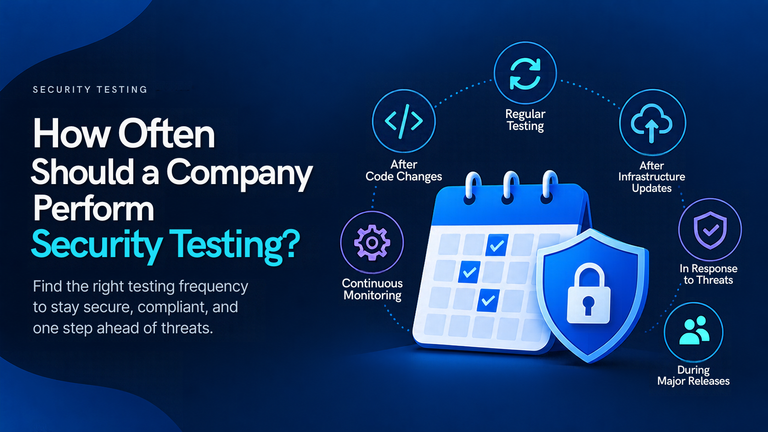
At a minimum, annually, and more frequently if your team ships features regularly. PCI DSS requires testing at least annually and after any significant change to the application. Beyond compliance, a web application that receives continuous development should be tested on a cadence that reflects its rate of change. Teams shipping major features quarterly should consider quarterly tests or a continuous testing program rather than relying on a single annual snapshot.
What vulnerabilities does a web app pentest find that automated tools miss?
Business logic flaws are the clearest example. A scanner cannot understand that your checkout flow allows a negative quantity to generate store credit, or that your password reset endpoint leaks whether an email address is registered. Authentication bypass through parameter manipulation, insecure direct object references hidden behind legitimate-looking requests, chained vulnerabilities that individually score medium severity but together produce critical access, and GraphQL introspection abuse are all classes of vulnerability that require a human tester to find consistently. Automated tools find the known patterns. Manual testing finds the application-specific ones.
The Bottom Line
Web application penetration testing is not a compliance checkbox. It is the only reliable method for finding the class of vulnerabilities that cause real breaches, the ones automated tools miss, the ones sitting in business logic, and the ones that look harmless in isolation but devastating when chained.
The numbers make the case plain. Attackers exploit vulnerabilities in 5 days. Organisations take an average of 74 days to remediate them. That gap does not close itself. Testing, specific remediation guidance, and confirmed fixes are what close it.
If your web application handles user data and has not been tested by a human who thinks like an attacker, it has not been tested at all.